How Running Can Reveal Pelvic Floor Problems After Childbirth

| 5 min read

Running exposes pelvic floor problems that often go unrecognized

A runner can be fit, experienced, and still find that childbirth has changed what her body can handle. For Liz B., a 36-year-old from central Ohio, the surprise came five months after giving birth: on a chilly December run, she began leaking urine. “What fresh hell is this?” she thought. The problem, which she prefers to discuss without using her full name, is far from rare: urinary incontinence affects 25 million American adults.
The stigma around it can make the experience even harder to talk about. Running had been part of Liz’s life since toddlerhood, when her father took her jogging. He ran his 91st marathon at 77; she grew up to run eight marathons herself, coming within eight minutes of qualifying for Boston. Before having a child, a Saturday 16-mile run with her sister sounded like a good time. She’d imagined running with her baby in a stroller, too. Pregnancy disrupted that plan. At 19 weeks, peripheral blood clots and pain forced her to cut back on exercise. After a difficult labor, she developed pelvic organ prolapse: weakened muscles had allowed pelvic organs such as the uterus or bladder to descend. With help from a pelvic floor therapist, she began a gradual return to running. Six weeks into that effort, her pace was still far from its former eight-minute-mile mark. “Once I had my baby, my pace slowed to a 10:30 mile,” she says. “And if I ran under a 9:00, I’d pee my pants a little.” That’s more than a frustrating setback. It shows how running can reveal pelvic floor trouble that might otherwise go unnoticed. Research suggests about one in three women and one in six men will experience pelvic floor dysfunction in their lifetime, and those figures count only reported cases. Pregnancy and childbirth can contribute to weakness, alongside hormonal changes and added weight. Running also puts repeated demands on those muscles. With every stride, the pelvic floor absorbs impact and helps dampen vibration, says Julie W. Wiebe, a Los Angeles physical therapist who works with women returning to fitness after injury and pregnancy. “Running creates an added challenge to your pelvic floor beyond the movements of everyday activities,” says Carrie Pagliano, a pelvic floor specialist in Arlington, Virginia. “It puts greater impact and pressure on your musculoskeletal system.” Pull quote surrounded by bright graphics
Lettering and illustrations by Lindsey Made This
The obvious assumption is that a pelvic floor problem means weak muscles that need strengthening. That can be true, but it isn’t the whole story. The pelvic floor must contract and lift; it also has to relax. Treating every problem as weakness risks missing what’s actually going on.

What the pelvic floor does—and what can go wrong

These muscles span the space from the pubic bone to the tailbone. They support and protect the bladder, urethra, vagina, prostate, bowel, rectum, and anus. They help you hold urine until you reach a bathroom, contribute to erections and orgasms, and bear substantial strain during vaginal birth. Urine leakage is one familiar sign of pelvic floor dysfunction, but it’s only one. A small study found that about 46 percent of elite female endurance runners and cross-country skiers reported leaking urine while sneezing or coughing. Yet leakage may be the symptom least likely to send a runner to a clinician; Pagliano says some fear they’ll be told to stop running. Other problems that bring runners in include difficulty urinating or defecating, persistent or sharp pelvic pain, prolapse, and fecal incontinence. These conditions often go undiagnosed. Shame keeps people quiet, and many don’t know where the pelvic floor is or what it does. But, as pelvic floor physical therapist Sara Reardon puts it, “They need training, they need relaxation, they need strengthening, and they need attention.” Reardon, a board-certified specialist in New Orleans, argues that calling these problems normal can keep people from seeking care: “Pelvic floor problems are common, but not normal, and it’s the conversations about them that need to be normal.” The gaps in understanding are larger than the stigma alone. Wiebe says pelvic health has received little attention, while women have historically been underrepresented in medical research. Because pelvic floor problems are often framed as postpartum issues, men have also been left out of much of the discussion. Researchers are only beginning to understand the effects on men. Five purple circles aligned horizontally

Strong muscles can still fail to do their job

Gordon Garner learned that the hard way. An hour after finishing a 20-mile training run, the 38-year-old software development manager called his wife to say he was driving himself to the emergency room. He’d spent the previous year progressing from Couch to 5K to training for his first marathon, aiming to finish in under four hours. That day, he held his goal pace, stopped every six miles to drink, and felt good enough to consider adding more distance. He stuck to the plan. Back home, though, he couldn’t urinate. After a shower, only a few drops came out, and the pain was intense. Doctors ruled out kidney stones and used a catheter to empty his bladder. Garner says he has a high pain tolerance—he’d broken both wrists playing basketball and fractured an elbow in a bicycle fall—but the catheter was excruciating. The hospital discharged him without an explanation. The problem returned at mile 12 of his marathon. Unable to urinate at a public restroom, Garner kept running for another six miles before dropping out. Two misdiagnoses, three prescriptions, and several more appointments followed before a physical therapist identified the cause: his pelvic floor muscles were contracting continuously and wouldn’t release. The diagnosis was hypertonic pelvic floor dysfunction. Person tying shoes with colorful abstract elements in the background
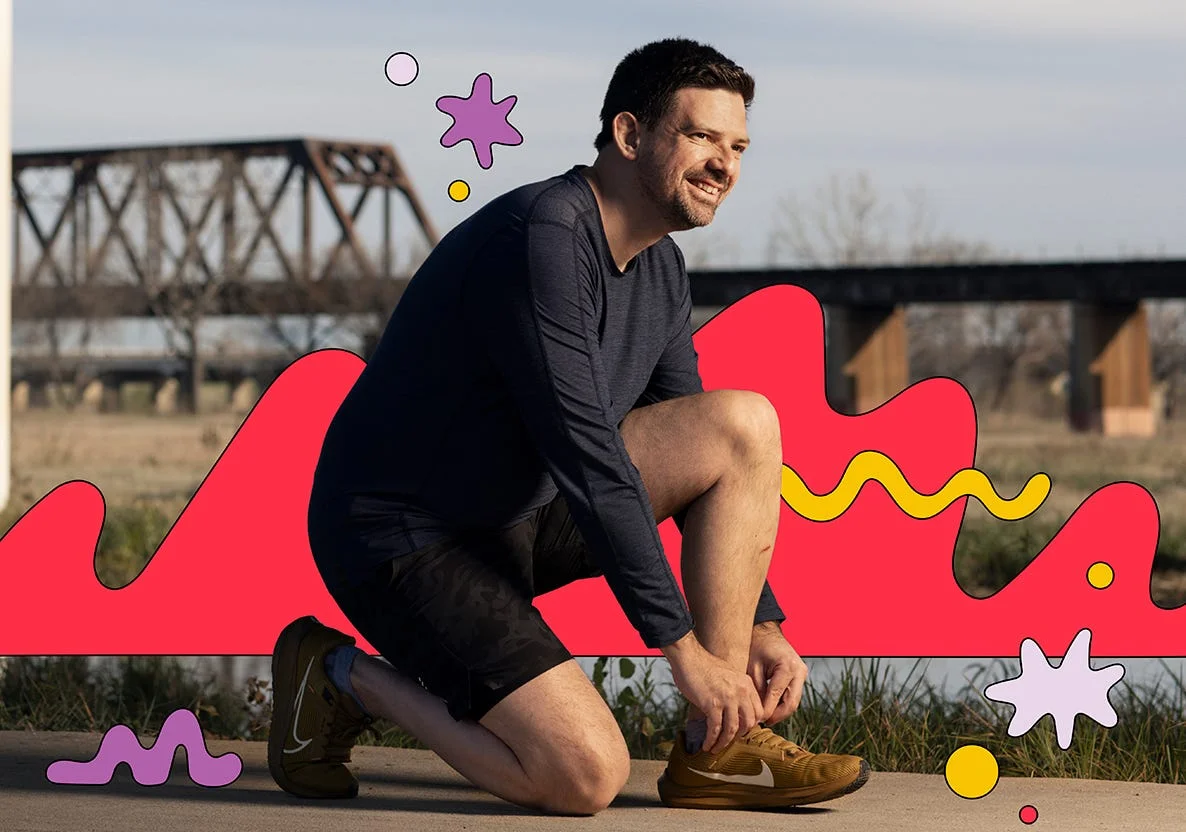
Photo by Justin Clemons. Illustrations by Lindsey Made This. Gordon Garner saw several practitioners before finding a specialist who could explain his symptoms.
Garner’s case points to a blind spot in the usual advice. Kegels and other exercises to strengthen weak muscles are often presented as the answer, but the pelvic floor also needs to loosen. “Your pelvic floor can be plenty strong but not meeting the demands that are being placed on it because it’s not behaving the way you need it to,” Wiebe says. A muscle held in constant contraction may be strong, but it can’t also release when the body needs it to. Strength alone doesn’t explain every case of leakage, either. A 2021 meta-analysis in Cureus Medical Journal concluded that urinary incontinence can occur even with a strong pelvic floor. Some young female runners who have never given birth experience leakage, and Wiebe says studies have found similar pelvic floor activation in runners who leak and those who don’t. How the muscles hold up over time may matter as much as their strength in a single moment. Someone who stays dry during daily activities but leaks near the end of a 45-minute run may have enough strength, but not enough endurance. Cut the run to 35 or 40 minutes, Wiebe says, and the leakage might not happen at all.

Pelvic floor function is about coordination

The pelvic floor has to adjust constantly, not simply switch between “tight” and “relaxed.” Carrie Pagliano compares it to a dimmer: during running, the muscles lengthen and shorten, changing their effort with each foot strike. That distinction matters. If the muscles are already working too hard, adding more squeezes may miss the problem. They also share the work of managing impact with the ankles, knees, hips, and other muscles. When balance or impact control elsewhere in the body falters, Pagliano says, more demand can land on the pelvic floor. She jokes that it becomes “the mom of the body,” picking up tasks other muscles leave undone. a series of five purple circles aligned horizontally Colleen Quigley’s experience shows how easily pelvic floor issues can hide behind other symptoms. For five years, the steeplechase specialist, NCAA champion, and current 4 x 1500-meter relay world-record holder dealt with recurring left-foot injuries, lower-back pain, and hip pain that eventually kept her from training at a high level. She consulted more than 50 specialists and even traveled to Germany for back injections. One practitioner found tension in her pelvis, then had her try a tongue stretch aimed at relaxing her jaw. Quigley says the pelvic problems identified during muscle testing disappeared afterward. Julie W. Wiebe explains the proposed link simply: the jaw and pelvic floor sit at opposite ends of the alimentary tract and can carry related tension. athletic individual demonstrating strength with arms raised surrounded by colorful graphics

Courtesy Lululemon. Illustrations by Lindsey Made This. Colleen Quigley was surprised to learn that some of her symptoms were related to pelvic floor issues.
Quigley’s warmup stretch drew a strong response on Instagram, earning more than 42,000 likes. It didn’t cure every injury, but it helped with symptoms that had resisted explanation. The broader lesson is less tidy: pain in the back, hip, or hamstring may involve pelvic floor dysfunction, but that connection needs careful assessment rather than guesswork. One Canadian study found pelvic floor muscle dysfunction in 95 percent of women screened at an orthopedic clinic for lower-back and pelvic pain. That figure points to a possible blind spot in symptom-led care. Reardon also notes that deep hip stability muscles are part of the pelvic floor, and dysfunction can be associated with deep hip pain or high hamstring strain. Symptoms may also appear during bowel movements or sex. ### Treatment depends on what the muscles are doing There’s no single fix for every runner. Pagliano says stride, form, and breathing can all matter. Runners who brace their abdomen or routinely hold their breath may develop pelvic floor muscles with too much tone—muscles that struggle to relax. In that situation, strengthening alone may not help, especially if the muscles are already overactive. Gordon Garner found a therapist who helped him reduce his running for a few weeks while practicing stretches and breath control. In 2023, he ran 40 miles in 24 hours to mark his 40th birthday, without the problems he had feared. Liz, after working with a therapist on strength and muscle coordination, returned to racing and completed her ninth marathon 20 months after giving birth without midrun leakage. Pelvic floor symptoms can improve with appropriate care, but finding the right clinician may take persistence. Reardon tells clients that some exercises will remain part of life if they plan to keep running. That’s a real commitment—and a useful reminder that the goal is not simply to squeeze harder, but to help the muscles respond when the body asks them to. ### A simple check for tension or weakness Lauren Garges, DPT, who directs pelvic rehabilitation at St. Luke’s University Health Network in Bethlehem, Pennsylvania, suggests this basic self-check for possible overactivity: - Sit on a large stability ball or a rolled towel so you feel pressure against the perineum, the area between the genitals and anus. - Use the muscles you’d recruit to hold back urine or gas, imagining that you’re lifting a marble upward. - Then try to release and let the muscles descend, as if an elevator were coming down. If you can squeeze upward but can’t feel a downward release—or nothing seems to happen when you try to contract—Garges says tension may be involved. Difficulty contracting can point to weakness. This check can offer a clue, but a pelvic floor clinician can assess what’s actually happening. ### Two exercises to try with the right guidance **For strength: kegels.** Nora Arnold, DPT, a pelvic health physical therapist with Johns Hopkins Medicine in Baltimore, recommends checking with a pelvic floor therapist before adding kegels, particularly if you have incontinence or other symptoms. They’re not right for everyone. If a therapist recommends them, start lying down, then practice sitting and standing. Contract as though holding back gas or stopping urine, and imagine drawing the pubic bone and tailbone toward each other, bringing the sit bones together, and lifting the pelvic floor toward the heart. The movement should include both a squeeze and a lift. Relax fully between repetitions and keep breathing; don’t practice by stopping your urine midstream, which can raise the risk of a bladder infection. A physical therapist can set an appropriate number of repetitions; Arnold suggests 3 sets of 10 contractions held for 10 seconds as a possible starting point. **For relaxation: belly breathing.** Arnold says a full diaphragmatic breath encourages the pelvic floor to lengthen and relax. Lie on your back, or try child’s pose, happy baby, a deep squat, or a reclined seated position. Breathe in through your nose for four counts, allowing your belly and pelvic floor to soften, then breathe out through your mouth for six. Aim for five to 10 minutes a day, though even 10 repetitions may help. ### Choose a therapist who understands your needs For runners, Wiebe recommends finding a pelvic floor therapist with experience in both sports medicine and pelvic health. Postpartum patients may want someone who has worked with new mothers; men may prefer a clinician experienced in treating male clients. The [American Physical Therapy Association’s provider directory](https://www.aptapelvichealth.org/ptlocator) can help locate a therapist, and patient reviews can offer more context. Remote appointments may also be an option. Pagliano says she has provided telehealth care since before COVID-19 and that a detailed history can help identify why symptoms occur. Be ready to share relevant details, such as childhood bedwetting, birth history, and when symptoms show up. Some care may require an in-person visit, but distance alone doesn’t have to end the search. Garner, Quigley, and Liz each tried multiple practitioners before finding someone who helped. Reardon’s comparison is apt: one poor fit doesn’t mean you should stop looking. Pelvic floor problems can affect running, breathing, laughter, and everyday movement. The useful next step is to find a clinician who can work out whether your muscles need to strengthen, relax, or coordinate differently.
Source: Richard Miller · www.runnersworld.com