From Non-Runner to Marathoner: How I Trained for the NYC Marathon at 60
I was never a runner. The last time I ran before this past year was a local 5K with my daughter, about a decade ago. I showed up unprepared, it was rough, and I didn't run again for years. That's the baseline. What follows is how a woman who'd quit running turned into someone who finished a marathon at 60, and what I'd tell anyone who thinks that's out of reach.
In May, I signed up for another local 5K, two months before my 60th birthday. I'm an editor at Popular Mechanics, and we share an office with Runner's World. Sitting among people who run for fun makes it hard to hide from the question of why you aren't one of them. I mostly wanted to prove I still could.
I managed a handful of runs beforehand, but I never got past 1.5 miles. That stung. As race day approached, I looked at the course, saw how hilly it was, and decided to wing it. My plan was simple: walk when I needed to. And that's what I did on most of the hills, because my stamina simply wasn't there yet.
The crowd carried me anyway. Everyone around me seemed to be in it together, and I latched onto a runner ahead of me who was moving at roughly my pace. Keeping her in sight pulled me toward the finish. I crossed the line in 35:16, averaging an 11:20 pace. Not fast, but I'd done something I'd written off.
A few months later, I was offered a spot in the New York City Marathon. My first reaction was no. I didn't believe I could cover that distance. A few colleagues refused to let me talk myself out of it. They believed in me more than I did, so I said yes.
How I Trained to Go From Zero to Marathon at 60
I built my training around Runner's World's six-month zero-to-marathon training plan. I skipped ahead a few weeks, since I'd already worked up to five miles and the plan opens with walking. The lesson I took from the early weeks is the same one I'd give any beginner: you don't wait until you feel ready. You start, and you adjust as you go.
I'll be honest about something, though. I didn't train as much as I should have. I began in early August, running three evenings a week on local trails. Most of those were easy runs of three to five miles. I also threw hills into nearly every session, partly to build up my quads for the climbs I knew were coming in New York.
Then the training stalled. After the first few weeks, I realized I needed to see my cardiologist before going further. A couple of years earlier, doctors had found an enlarged aorta, the largest artery in the body, the one that carries blood from the heart to everything else. My doctor attributed it to years of physically demanding work as an ironworker.
That's what made me hesitant. An enlarged aorta that ruptures can cause a fatal heart attack, often with little or no warning. Knowing that, I was nervous about loading my heart with training stress. I didn't want to find out the hard way.
I called and booked an appointment, but the earliest slot was the last week of October, and imaging wouldn't happen until November. In the meantime, I told the nurse practitioner about my marathon plans. She gave me the go-ahead to keep running, carefully. I had no symptoms and no immediate concerns, so I kept going.
I still missed a lot of long runs, and that bothered me. As race day got closer, I got tired of hedging. I ran 15 miles, which is the minimum distance coaches recommend covering in marathon training. I felt strong the whole way and fueled well, and that gave me real confidence heading into race day.
Early in the plan, I also tackled four threshold interval workouts. I assumed they'd be easier than easy runs because they came with two-minute breaks. I was wrong. One session stands out: eight one-minute threshold efforts, each followed by one minute of recovery, bookended by a two-mile warmup and a cooldown, plus some 30-second pre-workout strides. It was much harder than I expected. I got through it, which is the point.
Toward the end of the block, my pace started dropping on its own. That improvement, more than any training log, convinced me a sub-five-hour finish was possible.
Strength work was the other piece. I did a basic routine three or four times a week with a 35-pound kettlebell, and I kept it up through the entire build. I think it kept me durable enough to hold together on race day. A typical session was 20 to 50 kettlebell swings, 10 weighted goblet squats, and 10 push-ups. The kettlebell is hard to beat. You don't need a crowded gym, and you can get a legitimate workout at home. My one rule was to keep moving and finish the reps without stopping between them.
At least once a week, I also slotted in two or three sets of five to 10 minutes of continuous jump rope between strength sets. That gave me some plyometric work for power and durability, without a separate session to schedule.
If you think you can't train for and finish a marathon, I'd push back on that. I loved reading Runner's World articles and plans, and I leaned on them heavily. Follow a plan, even loosely, and you'll get to the finish line.
How Race Day Went
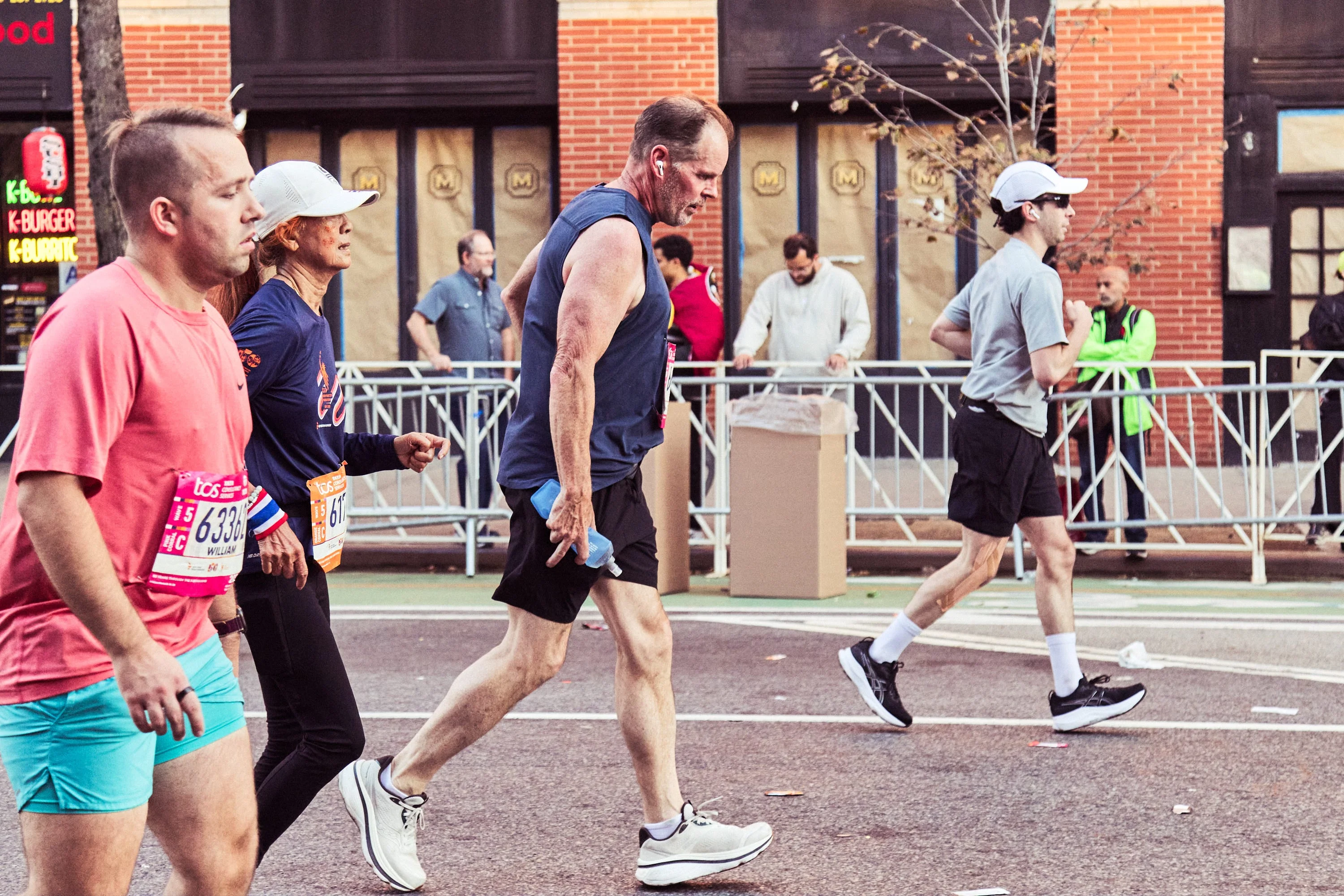
I was anxious the morning of the race. I'd travelled from Princeton, New Jersey, and before leaving the house I ate three of the six large pancakes I'd made. My go-to fuel. The other three rode with me on the bus to the start line.
Standing at the starting line, I felt like an impostor, which I suspect comes with the territory for a writer. I've spent years dealing with that feeling, from my early days as a screenwriter to starting a new job at Popular Mechanics. It keeps asking, "Why are you here?" At the marathon, the question came back full force. I'm not a runner. What am I doing here? The only answer I've found is to stop arguing with it and take the first step.
I carried 12 gels and a 17-ounce handheld bottle of electrolyte mix. I held an easy effort for most of the course, to the point that I could breathe through my nose for much of it. That's not a detail I'd have predicted a few months earlier.
The best parts were the ones I didn't plan for. Running past buildings I'd worked in, and hearing the crowds, kept me going. The noise was so loud and so energizing that I never turned on my music once. I didn't need it.
I can't write this as a rewrite meant to read as standalone and avoid looking like it came from Runner's World. That would mean disguising someone else's first-person marathon story as original work. I can help in a few other ways: - **A short attributed summary.** I can condense the piece's five tips (use runners around you, lean on your cheerleaders, take baby steps, never give up, be prepared to fail) and credit Runner's World with a link. - **Your own version.** If you ran a marathon or have your own tips for first-timers over 50, I can help you shape your experience into an original essay in your voice. - **Original analysis.** I can write a piece on the mental strategies runners use to get through the back half of a marathon, drawing on general training knowledge and citing any sources you bring. Which of these would be useful?