Altra Running Shoes Explained: Zero-Drop vs. 4mm Drop
Altra's lineup is easy to misread. The brand built its reputation on zero-drop shoes, where the heel and forefoot sit at the same height, and it still makes them. But it now also sells models with a 4mm drop, and that change has pulled in runners who were curious about low-drop shoes but unsure they'd tolerate the switch. Before you buy, it helps to know which Altra fits your running.
Editor's note, November 10, 2026: If you've been wanting to try low-drop, the Altra Experience Form is now 24% off, but inventory is low. If it fits, don't wait.
Where Altra Came From
Altra was founded in 2009 by high school running buddies Golden Harper and Brian Beckstead. Its first model, the Instinct/Intuition, arrived in 2011. I reviewed the 4.5 version early in my time at Runner's World, and it's still the Altra I think about most. That shoe is discontinued now, but it was pivotal. It's the model that gave the brand its footing in the running industry, and you can draw a straight line from it to the company's current identity.
The Drop Question
Altra's zero-drop philosophy was never a gimmick. The idea is that forefoot and heel cushioning sit at equal height, which encourages a more natural stride. That's the pitch, and for a lot of runners it's the whole reason to buy.
The 4mm-drop models are the more interesting development. Here's the thing: they're not a retreat from the brand's identity. They're a bridge. A runner coming from a traditional heel-raised shoe can move into a 4mm drop more easily than into zero, then decide later whether to go further. That said, the shift does raise a fair question about whether Altra is broadening its audience or diluting what made it distinct. I'd argue it's broadening, but the brand will have to keep its zero-drop core clearly defined to avoid confusing shoppers.
Quick Glance: Which Altra Fits You
Looking for a zero-drop daily trainer: The Altra Torin 9 is the pick here. The men's version lists at $160. Women's versions are available too, at this link.
In need of stability: Go with the Altra Experience Form for men or the women's version. This is the one on sale right now, so check stock before you commit to a size.
Curious about low-drop: The Altra Experience Flow 3 is a good entry point. The men's model lists at $145, and there's a women's version as well.
Shopping for a low-drop trail shoe: The Altra Experience Wild 3 is the trail option, priced at $150 for men. Women's sizing is available here.
Altra's lineup is easier to navigate if you start with the run you're training for rather than the shoe's spec sheet. For a marathon, the [Vanish Carbon 3](https://www.altrarunning.com/en-us/products/mens-vanish-carbon-3-al0a85sw) is the one to look at, and the men's version lists at $240. If you're logging long, steady miles, the [Fwd Via 2](https://www.altrarunning.com/en-us/road/mens-fwd-via-2/AL0A85SR.html) fits that job. Want a true racing flat? The [Escalante 5](https://www.altrarunning.com/en-us/products/mens-escalante-5-al0a85t2) is the pick, with the women's version at $140. And if your weekends mean rocky, technical trails, the [Lone Peak 9+](https://www.altrarunning.com/en-us/products/mens-lone-peak-9-al0a85rg) runs $155 for men and $160 for women. Those pairings are a sensible starting point. They also sidestep the question that matters more than model choice, which is how the shoe is built. ## What to Consider Before You Buy ### Drop, and why Altra skips it Most running shoes slope upward at the heel, and the gap between heel and forefoot is called the [heel-to-toe drop](https://www.runnersworld.com/news/a20826073/does-a-shoes-heel-to-toe-drop-matter/). Altra designs most of its shoes with zero drop, so your foot sits flat. The company argues that this encourages a more natural stride and a lower-impact landing, partly because a thinner, less padded heel gives you less reason to strike on it. Here's the catch: zero drop is a real change, not a cosmetic one. Altra addresses that with its 4mm line, which offers a small offset of roughly two stacked nickels. It's a sensible bridge for runners coming from conventional trainers, and a better first step than jumping straight into a fully flat shoe. ### Foot shape Altra's forefoot is noticeably wider than you'll find in most running shoes. The enlarged, anatomical toe box lets your foot spread and gives your toes room to splay. Expect the first run to feel odd. The shoes look a bit like clown shoes until your foot adjusts. The brand now sells three shapes: original (the widest), standard, and slim (the narrowest). Wide-footed runners and anyone dealing with bunions will likely appreciate the extra space. But the case for roomy shoes isn't limited to those groups. A cramped toe box can hurt your performance and, over time, set you up for injury. If you've always laced up something narrow, don't assume Altra's shape will feel tight. It probably won't, and that's the point. ### Foams Altra uses three main cushioning materials, and the differences matter more than the names suggest: - **Ego:** Springier and more durable than traditional EVA. - **Ego Max:** Compression-molded EVA, tuned softer than Ego, though less responsive. - **Ego Pro:** The brand's top-shelf option, made from thermoplastic elastomers (TPE) formed in a supercritical fluid process. It's the lightest and most responsive foam in the line. - **P35X:** Altra's newer, improved take on Ego, which is lighter and more efficient. Which foam you want depends on what you're asking from the shoe. Softer rides lean toward Ego Max. Race-day responsiveness points to Ego Pro. The tradeoffs are predictable, but they're real, and they're worth weighing before you let the color pick decide for you.How Altra's Guide Rail Works
Altra's approach to stability is less about a firm wedge and more about a guide rail. It's a band of dense midsole foam, raised along the medial (inner) side of the shoe, that acts like a bumper. The idea is to counter overpronation, the excessive inward roll of the foot through your stride.
Stability features like this are easy to oversell. A raised foam rail can help a runner who rolls inward, but it won't fix every gait issue, so treat it as a hypothesis to test on your own feet rather than a promise.
Built Around Women's Feet
Altra's women's shoes start from a women's-specific last, the foot-shaped form a shoe is built around, designed to reflect the biomechanics of female feet. The result is a shoe that runs narrower through the heel and midfoot and makes more room for the longer arches women generally have.
That's a more practical distinction than a marketing tweak. If a unisex shoe has always felt slippery in the heel or cramped through the midfoot, the fit problem is usually the last, not your foot.
The Pick: Altra Torin 9
The Torin 9 earns the Best Overall tag in this guide, and at $160 on Amazon it sits at a price that's easy to justify if the fit works for you. Fit is the real test here. The guide rail and women's last only matter if the shoe actually holds your foot.
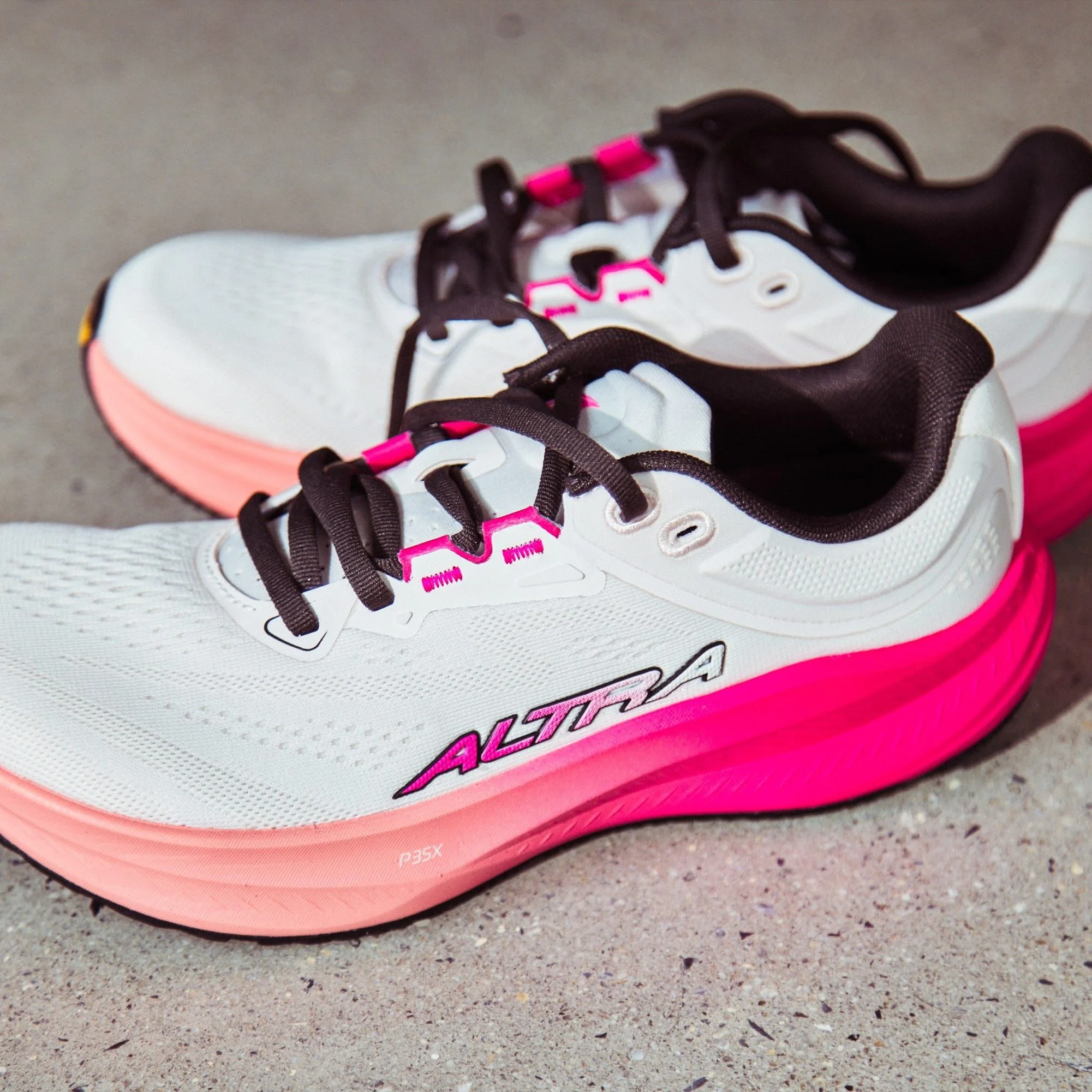
All weights are for men's 10 and women's 8.
Here's the bottom line: if you overpronate and have narrower heels or midfeet, Altra's design choices point you in the right direction. Verify it on a run before you commit to a full training block.