Conner Mantz Rebuilds After Injury With the 2028 Los Angeles Olympics in Sight
A national record can make an athlete look untouchable. Conner Mantz’s story is more complicated: after setting the American marathon mark, he pushed too hard, suffered the biggest injury of his career, and had to rebuild from a sacral stress fracture. His ambitions are already pointed at the 2028 Los Angeles Olympics. His body, for now, is asking him to slow down.
Record holder at home
On a cold Friday in February, Mantz and his wife, Kylie, are in their usual evening routine at home in small-town Utah: sweats, dinner, conversation. Running generally dominates the talk. These days, pregnancy is in the mix too; Kylie is a few months along with their first child, as are at least two neighbors. Tonight’s subject is less glamorous: a crack in the ceiling and the home warranty about to expire.
Kylie spotted the crack just days before the one-year warranty ran out on their new four-bedroom, 4,500-square-foot house in a master-planned community. The place still looks newly occupied: a nearly empty kitchen, cardboard boxes waiting to be unpacked, and a bright-white interior with little on display beyond a wooden sign quoting Joshua 24:15: “as for me and my house we will serve the Lord.”
There’s also a Samsung Frame TV mounted in the living room. It’s built to pass for a framed picture, with images selected from a library of artwork. Conner gave it to Kylie for Christmas, though they’ve rarely watched television during their three years of marriage. “Which makes it kind of funny that we bought it!” Kylie says, scattering frozen broccoli on a sheet pan.
The joke has a second layer: they haven’t chosen any art for the screen. It’s still just a TV, with neither Claude Monet nor the 2026 Winter Olympic Games on view. Maybe the Summer Olympics would hold their attention. If his training goes to plan, though, Conner won’t be watching the 2028 Games from the gray Costco couch in Mapleton, Utah. He’ll be racing the marathon in Los Angeles, chasing a medal and a personal best.
That personal best is already the American marathon record: 2:04:43. Mantz took it from Khalid Khannouchi, whose mark had stood for more than two decades. After saying last year that he’d break the record, Mantz did it on a crisp October morning at the Chicago Marathon. He finished fourth, six seconds behind Kenya’s Alex Masai in third, and nearly a minute faster than Khannouchi had run in London in 2002.
There was no theatrical collapse at the finish. Mantz stopped his watch, shook hands with competitors, drank some water, and stood around in Nike Alphaflys and royal-blue split shorts as if he’d just completed an ordinary race. But the record didn’t feel like enough. “I just felt like I had more in me,” he says while pushing Italian sausage around a pan; Kylie blends cottage cheese into tomato sauce for extra protein. “I was a little bit kicking myself.”
What he wants is a place on the podium, ideally at the very top, among the East African runners who have long dominated distance racing. That ambition makes the injury that followed Chicago more than a setback in the calendar. It interrupted the very pursuit that gives the record its meaning.

Learning to run again
The next day, over lunch at Ginger’s Garden Cafe, Mantz is nowhere near the podium. He’s recovering from the worst injury of his career: a sacral stress fracture that kept him out for 12 weeks. Pool laps, physical therapy, and watching running friends’ posts replaced training. He says the forced break left him depressed.
“I got too excited,” he says. After Chicago, he’d felt unusually fresh and returned to hard training too quickly. He was aiming for a medal at the 2026 World Athletics Cross Country Championships in Florida that January, and admits he didn’t listen to his coach. The marathon record began to feel remote. “I actually don’t even feel like I broke the American record,” he says. “I get the record, and then I get injured? It humbles you.” Then he adds: “It’s like: Just in case you think you’re the man, now you’re not even walking.”
He’d only been running outdoors again for two weeks. The first run back felt, in his words, as if he weighed a million pounds; his legs seemed to sink into the ground. That winter morning, he covered 20 miles on the Provo River Parkway Trail at an average 5:45 pace, at 4,500 feet of elevation, according to Strava. He often posts there for more than 60,000 followers. The run was hard enough that his couch had started calling. “It’s okay. Kylie drove,” he says when I apologize for bringing him out, then smiles as he sits down beside her. “I’m just glad I get to sit.”
Lunch wasn’t my first choice either. The Wasatch foothills around Provo offer decorative rock yards, plenty of dentist offices, and a quilting shop; excitement takes some searching. Beer was out in this Latter-day Saint community, and coffee too: the Church of Jesus Christ of Latter-day Saints prohibits alcohol and caffeine under its scripture. Whatever Jessi Draper and other “delinquent” stars of The Secret Lives of Mormon Wives may sometimes drink, that’s the local rule. The movie theater was showing the 1986 film Peggy Sue Got Married, while Clint’s Reptile Room was hosting a birthday party for a group of small blond boys.
I’d even asked Mantz, awkwardly, whether I—a middle-aged Jewish mother—could join him in the sauna. Partly, I was cold; partly, I knew he spends at least 20 minutes in one after every run. He declined politely. Coed nude saunas presumably aren’t part of life at Brigham Young University, where he studied, won two NCAA Division I Cross-Country Championships, and still trains under the legendary coach Ed Eyestone. It’s also where he met Kylie in a religion class during his junior year. When I asked on our first call what first attracted him to her, he laughed: “She’s a lot more interesting than me.”
At the cafe, they sit fully clothed over salads and turkey clubs with “facon bacon.” Kylie is more spontaneous in conversation, though she has her own running credentials: she walked onto BYU’s track team as a senior and ran a 2:43:49 in her first marathon last year, with Conner beside her. He likes his sandwich, but it can’t match the jollof rice he ate during his two-year LDS mission in Ghana after high school in 2015. He also loves fufu, made from cassava and plantains pounded into dough and served with soup. “It’s one of the most delicious things!” he says, biting into his sandwich.
In Ghana, his weight climbed by 30 pounds in eight months, from a lean 120 to 150. The food was part of the change, but not the whole explanation. “I was stressed out,” he says. Mission life meant a strict schedule and knocking on doors from dawn to dusk, hearing strangers’ stories, often about despair. Running, which had been part of his life since childhood, disappeared too.
He was assigned to stay with a companion around the clock, and that companion didn’t run. So Mantz couldn’t, either. “He didn’t do anything!” he says, looking at Kylie. She nods; this is clearly familiar territory. Mantz isn’t much of a complainer, especially about another person, but the memory still gets a reaction.
Eventually, the routine settled in: wake up, put on a white shirt and tie, walk, knock, talk, sleep, repeat. He cared about the people he met and admired their generosity and openness. The schedule itself was exhausting. It was also, he says, freeing. With one purpose and no phone, he didn’t have to think about money, school, friends, or family. “You’re not really aware of what’s going on in the world, either. You don’t know the news,” he says. “You come back two years later totally out of it.” He describes returning like an LDS Rip Van Winkle, still wearing jeans from two years earlier.
Coming home meant readjusting to American life, running, and a body that had changed. The structure he returned to was hardly loose: it became the repetitive, demanding life of a world-class distance runner.
A life built around focus
Eyestone says the LDS Honor Code sets rules for a “clean, moral lifestyle”: no smoking, alcohol, or premarital sex. He jokes that the last rule can be a downside for college students, adding that a third of his student-athletes are married. He also pushes back on the idea that Mormons are parochial: “We’re not wearing bonnets and driving around in covered wagons!”
For athletes, Eyestone argues, the faith’s daily structure can be an advantage. Once people see that it’s workable, he says, it can support both running and life beyond the sport. The BYU program and Provo have therefore drawn runners pursuing Division I or professional careers, whether or not they’re religious. The appeal, in his telling, is fewer distractions and a simpler routine.
Mantz was focused long before he became a record holder. At five, he said he wanted to go to the Olympics, though he didn’t know for what. He was the fastest kid at recess. At nine, after watching his older brother and father—a former college wrestler—run a half marathon, he begged to try one himself. His parents said no. He passed the time playing video games and competing in 5Ks until they relented when he was 12.
He ran his first half marathon in 1:33:27, then cut that to 1:22:43 a few months later. By 14, he’d run 1:11:24 at the Utah Valley Half. Eyestone noticed him at a BYU summer camp for young runners, where he coached both beginners and what he calls “child prodigies.” Mantz was the youngest in the front group, pushing the pace and running more than anyone else.
The defining feature of Conner Mantz’s rise isn’t one spectacular race. It’s the repeatability: the training group, the daily habits, and the expectation that he’ll keep showing up. That steadiness has carried him from college cross-country to the top of American distance running. It also makes the moments when he feels uncertain all the more revealing.
When Mantz graduated from Sky View High School in Smithfield, Utah, in 2015, he was a three-time Foot Locker Cross-Country Championship All-American and had plenty of college options. Princeton caught his interest. BYU’s track-and-field reputation was less formidable then than it is now, but the school had Ed Eyestone: BYU alumnus and two-time Olympic marathoner. Mantz had already verbally committed to Eyestone before leaving for Ghana. He reconsidered, asked his father for advice, and was reminded that he’d given his word. He kept it.
After redshirting his first year, Mantz became one of BYU’s standout runners. At the NCAA National Cross-Country Championship in Oklahoma—held in March 2021, though it was the 2020 championship—he won the 10K by more than 20 seconds. He was the first American champion since Galen Rupp in 2008. Later that year, he won again and set a course record at Apalachee Regional Park in Tallahassee. Shoe companies took notice; Nike signed him as a professional.
BYU has since become a distance-running powerhouse, producing Olympians and elite competitors including Jared Ward, Clayton Young, and Mantz. After turning pro, they chose to stay in Provo, training with Eyestone and with one another. That last part matters. For Mantz, the team’s shared standards have been as important as its coaching.
“At BYU, the older guys set a tone of, ‘We’re going to be great, and if you don’t want to be great, that’s fine—but then this team isn’t for you,’” Mantz says. The message was simple: turn up, take responsibility, follow the rules. Some rules were arbitrary. In 2017, the cross-country team imposed a season-long ban on dessert. Mantz now laughs at the idea, but says the point was that everyone was committing to the same thing. They planned to celebrate with a giant cake at the end. Then they forgot about it.
Forgot the cake?
Mantz’s first marathon came after he turned pro. He placed seventh at the 2022 Chicago Marathon in 2:08:16, the first American across the line. That label has followed him through most of his major races:
- 2022 Chicago: First American
- 2023 Chicago: First American
- 2024 Paris Olympics: First American
- 2024 New York City: First American
- 2025 Boston: First American
Boston in 2023 was a difficult exception. Mantz nearly blacked out from hypothermia and finished 11th in 2:10:25. Even so, the pattern resumed. At the 2025 Chicago Marathon, he became the fastest American ever, running 2:04:43—three minutes and 33 seconds faster than his 2022 debut. Earlier in 2025, he and Ethiopia’s Addisu Gobena crossed the line together at the Houston Half Marathon, where Mantz ran 59:17 and broke Ryan Hall’s 18-year-old record.
Those results make consistency sound like a convenient summary. For Mantz, it’s the goal itself. He names Eliud Kipchoge as the runner he most admires, pointing both to Kipchoge’s marathon record—ten majors and two Olympic golds across a ten-year period—and to the way he treats people. Whether scrubbing toilets at his training camp or speaking with strangers, Mantz says, Kipchoge is the same person on camera and off.

Mantz doesn’t seem to recognize the resemblance. Eyestone’s coaching philosophy gives it a name: C2 = E2, or consistent competence equals eventual excellence. In a 2015 address at BYU, Eyestone described how small, careful efforts accumulate into excellence. It’s an idea with a much older echo in Alma 37:6 of the Book of Mormon, published in 1830: “By small and simple things are great things brought to pass.” James Clear later made a related case in the 2018 New York Times bestseller Atomic Habits: “Intensity makes a good story; consistency makes progress.” Mantz’s career suggests he’s pursuing both.
Eyestone says Mantz is drawn to the limits of what he can do. His instinct, Eyestone says, is to ask why he shouldn’t push harder if he can. He’s also quick to find fault with his own performances. Eyestone searches for a word—“dissatisfaction,” he tries, then rejects as too harsh. “He’s not…content,” he says, before deciding that sounds negative too. The phrase he settles on is “ever-striving”: Mantz keeps chasing the elusive perfect race.
Was Chicago perfect? Eyestone calls it very close, a “pretty darn good race.” But Mantz finished fourth. He wants a podium, and Eyestone is sure that even a podium finish short of first place will leave him reaching for more.
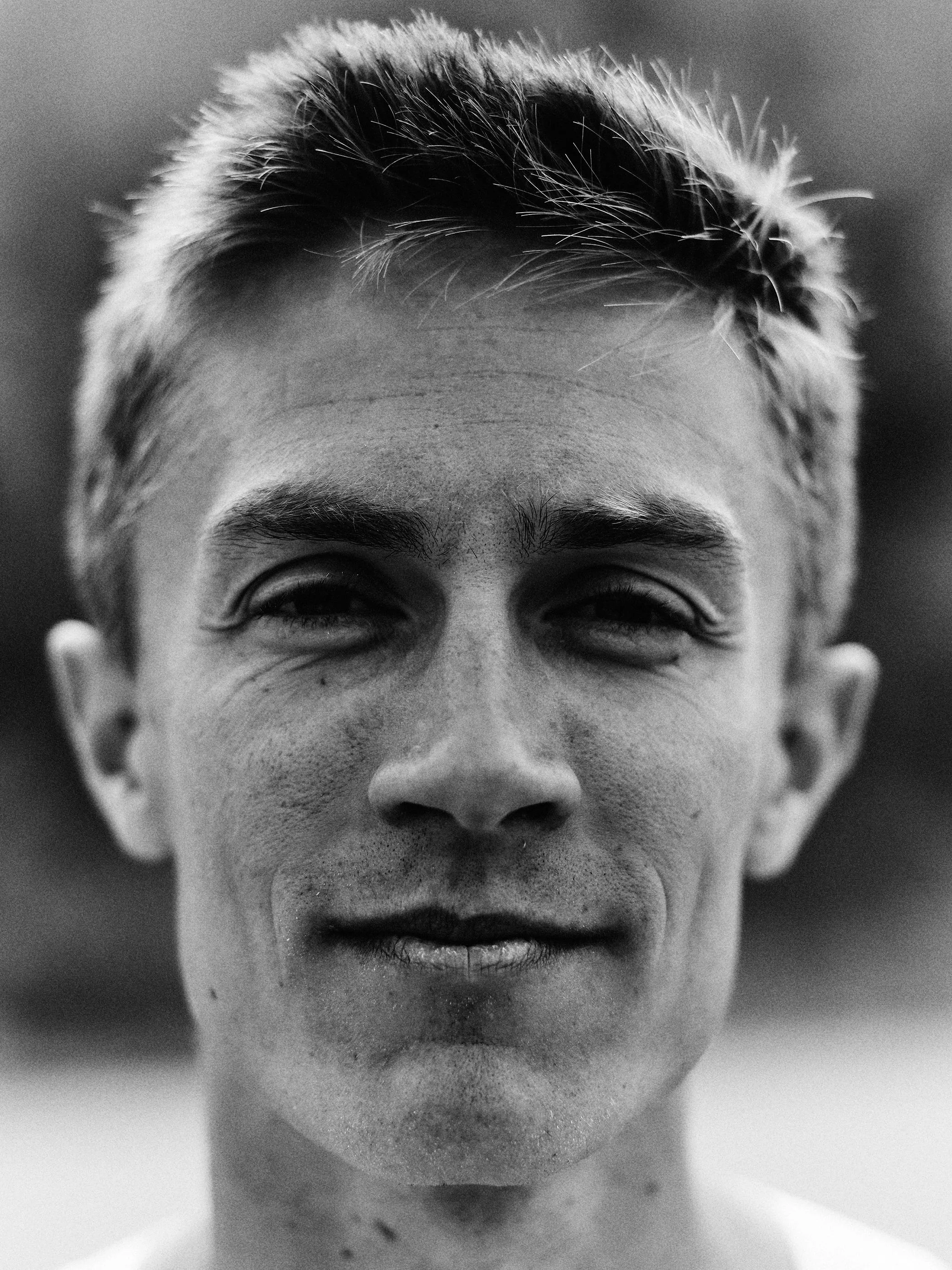
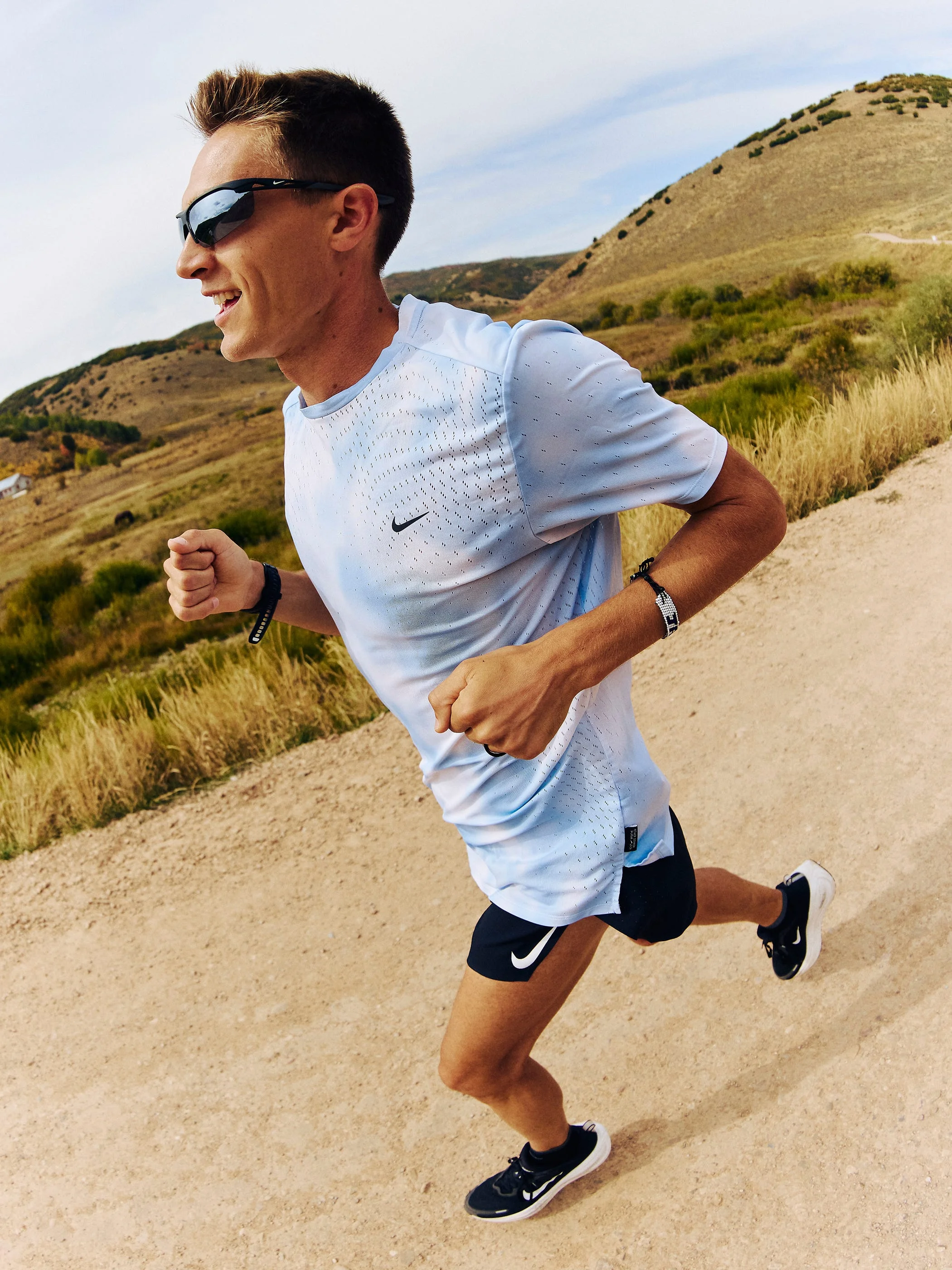
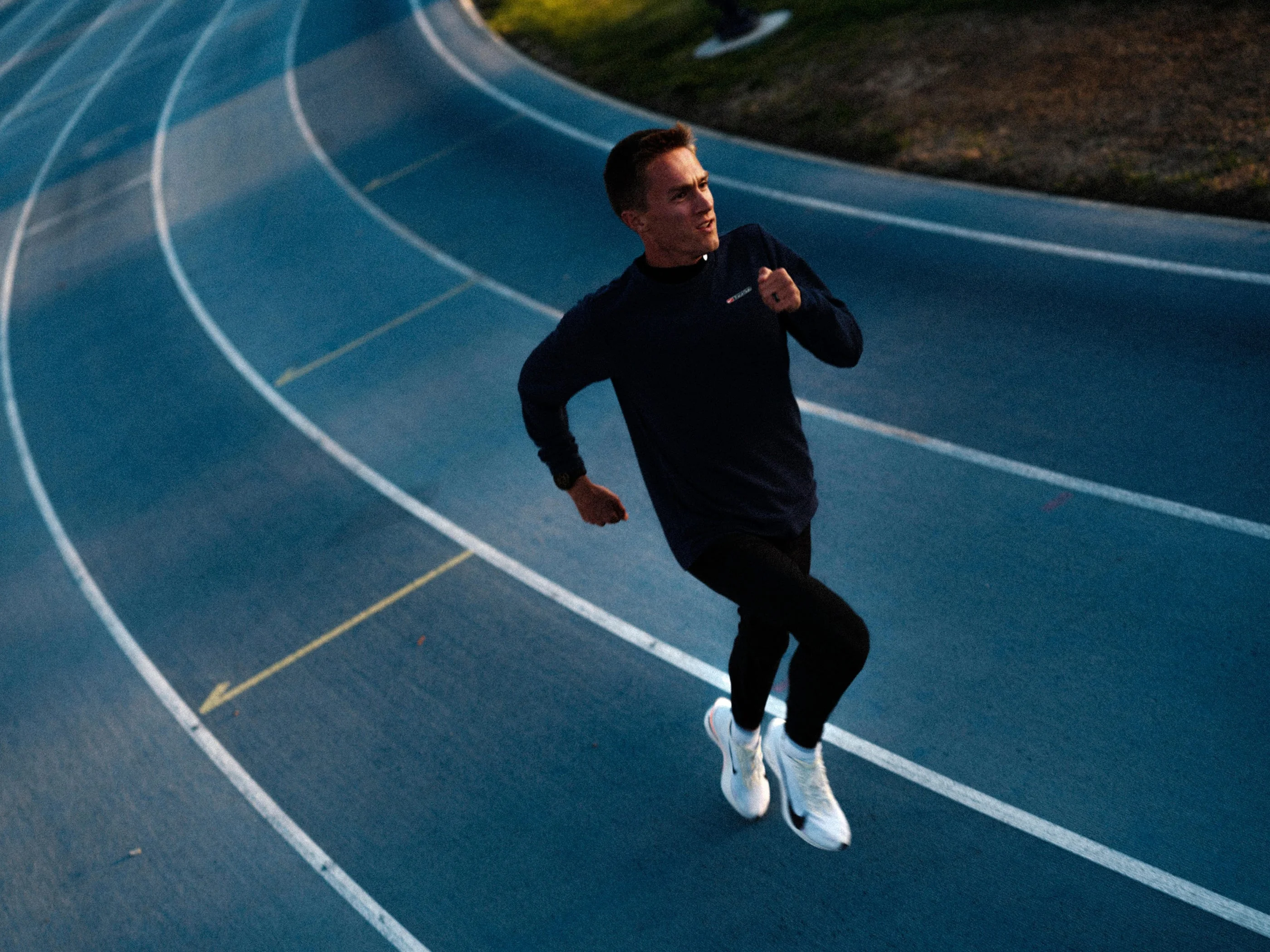
The ambition can be hard to square with Mantz’s manner. He’s gentle, quiet, and measured, with a slow smile and a boyish face; “holy smokes” sounds more natural from him than a champion’s boast. At 5 feet 8 inches and 130 pounds, with pigeon-toed feet and long, thin legs, he doesn’t look like the fastest American marathoner. Then he runs: head up, eyes fixed ahead, arms driving, legs firing. The contrast is striking.
Before a marathon, Mantz is usually in bed by 8 p.m. He often lies awake anyway. The night before he broke the American record in Chicago was no different. He says he was nervous and dislikes announcing his goals, but his training and times pointed to a clear target: the American record. The Bank of America Chicago Marathon put that goal in an official press release. Mantz described it plainly, without much fanfare.
In bed, the plain statement started to feel like a trap. If he failed, he says, he’d be disappointed—and feel stupid for having said it out loud.
Then he began worrying about the candy. Two days earlier, journalist Alex Cyr had given him a repackaged pouch of Sour Patch Kids after hearing Mantz liked them. Mantz ate at least ten. Later, awake in the dark, he wondered whether he knew Cyr well enough to trust the candy, whether it could have been contaminated, and what he might have taken.
That’s a small opening into the nerves behind Mantz’s composed exterior. His wife, Kylie, sees that side; so does Clayton Young, who has trained with him for thousands of miles since college. It showed up, too, over a long meal as Mantz talked through his worries. He may seem unshakeable, but he’s vulnerable to the same spirals as anyone else.
When the routine breaks
If 2025 was the best year of Mantz’s professional career—and perhaps of any American professional marathoner’s—then 2026 has, so far, been the hardest. In late March, he withdrew from the Boston Marathon, writing on Instagram that his fitness hadn’t progressed enough. He’d deleted the app from his own phone long ago; he still has an account on Kylie’s phone and rarely checks it.
Every runner needs recovery, and Mantz was no exception. Eyestone told me, days before the withdrawal was announced, that this was the first marathon they had agreed Mantz would run that he wasn’t going to start. Mantz was crushed. Pulling out of any race would sting. Boston was worse: he had given the world his word, and keeping it matters to him.
He flew to Boston anyway for the 130th annual April race, at the invitation of the Boston Athletic Association and his sponsors. He did a Nike shakeout run, joined a Shokz panel, and cheered on the runners he trains with under Eyestone: Rory Linkletter, Clayton Young, and the sudden star Kodi Kleven. All three set personal records.
Watching from the sidelines was difficult. When I called after the race, Mantz said he felt jealous: the morning was cool and clear, the conditions ideal, and he wanted to feel the nerves that usually come with race day. There was one upside. He slept well—something he wishes his new baby, born in July, would do.
He worries about plenty: candy, accidentally taking a banned substance, USADA testers showing up at his door, Instagram comments getting into his head, newfound attention, saying or doing the wrong thing, watching the documentary Conner Mantz: The American Record, and even reading this article. Running is different. “That’s the calming thing,” he says.
So is the rhythm around it. Mantz traces his reliance on routine back to Ghana, where its simplicity helped him focus. On Saturdays, he runs long with friends. Sundays are for church with family. He takes saunas after workouts and tries to have a weekly date night with Kylie. Tonight’s plan is Battleship and candy, an idea Kylie found on Instagram.
Before a race, he showers twice: once the night before and again in the morning. He admits that missing either shower would make him uneasy. It’s a small ritual, but rituals give the days their shape.
His ordinary training day is anything but spare. He gets up at 6 a.m. and eats a banana and a Maurten Solid 160 bar, sometimes with toast and jam. On a typical weekday, he runs 10 to 16 miles with friends, snacks every two waking hours, and often eats two lunches. On Tuesdays and Thursdays, when he lifts weights, Kylie packs a larger meal—sandwich, bars, fruit, and a protein shake—which he eats walking from the car to the gym. Around 1 p.m., he’ll have eggs or leftovers on the drive home, then rest and catch up on emails and texts. Later, he runs another four to eight miles alone, showers, eats dinner with Kylie, and goes to bed. The cycle adds up to 100 to 130 miles a week.
Conner Mantz’s routine may look narrow from the outside, but that discipline is part of what makes elite distance running possible. His Sundays are for church; other than occasional school talks or sponsor dinners at Magleby’s, his days follow a steady schedule. The driver, as it were, keeps his eyes on the road.
That focus leaves little room for television, art museum visits, or idle scrolling. Mantz’s attention is on running, religion, and now raising a child. Eliud Kipchoge once captured the paradox: “Only the disciplined ones in life are free.” Routine can look like a constraint, but it also clears space for what matters most.
Distance running has always struck me as gloriously, sometimes painfully, repetitive. I saw the point one morning while following my own familiar ritual: up at seven, brush my teeth, pull on black leggings, lace up my Sauconys, then head out for six miles, nine, or 13.1. I’ve done some version of that for decades. Mantz’s predictability isn’t an oddity. It’s part of the sport’s character. Some runners are more focused than others, but every mile asks for patience with repetition.
That sameness can produce extraordinary results: records, podium finishes, and the kind of career that invites the pun “be the Mantz.” There’s a lesson here even if you don’t share his faith: routine can offer both meaning and calm. For Mantz, it may also be part of a path toward Olympic gold in 2028.
When I catch up with him in early May, he’s returned from a babymoon in Hawaii and has family visiting. The crack in the drywall has been repaired. He’s still not fully healed, though he’s reluctant to say so.
The recent London Marathon has him thinking about what might be possible. He’s looking ahead to the Copenhagen Half Marathon in September. “If Sabastian Sawe and Yomif Kejelcha can break two hours, it makes me think, ‘What can I do?’” he says. “With the right race, on the right day… If I dot my i’s and cross my t’s, how good can I be?”
Then he pauses, apologizes, and heads off. There’s a run to get in—and a crib to assemble. For Mantz, the routine keeps going, now with a new life folded into it.

Rachel Levin is a San Francisco-based journalist and author of LOOK BIG: And Other Tips for Surviving Animal Encounters of All Kinds. She has written for the New York Times, the Wall Street Journal, Outside, the New Yorker, and Eater, where she was the San Francisco restaurant critic. An occasional columnist for the San Francisco Chronicle, she is co-author of EAT SOMETHING: A Wise Sons Cookbook for Jews Who Like Food and Food Lovers Who Like Jews, named one of Eater’s Best New Cookbooks of 2020.