Emma Grace Hurley’s Chicago Marathon Debut Sets an American Record
Emma Grace Hurley’s Chicago Marathon debut shows what patient planning can buy: not just a fast time, but room to learn the distance without treating one race as the whole career. She arrived with questions about the start, crowded aid stations, and what her legs would feel like after mile 20. She left with a result few first timers can match—and a useful case study in building toward a marathon gradually.
Hurley ran 2:20:47, finishing seventh among the women and first among Americans. That broke Fiona O’Keeffe’s American debut record of 2:22:10 and put Hurley sixth on the list of fastest U.S. marathoners of all time. She told reporters afterward, “I had fun the whole time,” even through the hard final miles.
That outcome followed years of deliberate preparation with coach Andrew Begley. The two had been working together at Atlanta Track Club since 2021 and saw the marathon as a future goal, but chose not to rush toward it. Their longer view was aimed at giving Hurley a strong shot at making the 2028 Olympic marathon team. The result makes a broader point for runners outside the Olympic pipeline, too: you can take several races to move up in distance or pursue a marathon goal, and that patience may pay off.
Short-distance speed can carry over
Hurley had a strong high school career, including a place among the finalists at the Foot Locker Cross-Country Championships, then ran for Furman University. She was competitive but not a standout at the NCAA Cross-Country Championships; her best finish was 51st. By graduation, her personal bests were 15:57 for 5K and 36:48 for 10K.
A race-time calculator puts a 15:57 5K runner near a 2:35 marathon. That’s fast by ordinary standards, but it doesn’t predict the level Hurley eventually reached. Begley saw room to develop her speed and efficiency before adding marathon demands. “The more efficient you are, the better—and the only way to get more efficient is to get faster at the shorter events, so that you’re running at a lower percentage of your max when you’re running the marathon,” he says.
Begley and his wife Amy, a 2008 Olympian who coached at Atlanta Track Club, kept Hurley’s weekly mileage below what many marathoners run—around 70 miles instead of 100 or more—while maintaining hard workouts. One weekly session was with 800- and 1500-meter runners such as Allie Wilson; another was with marathoners. For several years, Hurley raced from the 1500 meters through the 10K.
When the Begleys moved to Indianapolis in 2023 for Amy’s job with USA Track & Field (USATF), Hurley moved too. Andrew continued leading her training. Her current personal bests—15:01 for 5K and 31:00 for 10K—reflect that progression. She has also hit 31:00 several times in training, making marathon pace feel more manageable, she says.
The marathon hasn’t ended the shorter-distance work. Hurley plans to race no farther than a half marathon next spring, including seeking the road 10K Olympic Trials qualifier, then return for her second marathon in the fall.
Your takeaway: Consider a few training blocks centered on the 5K or 10K before your first marathon. Afterward, keep shorter races in the plan for at least one or two cycles each year.
Shoe choice is personal
At Furman and later with Atlanta Track Club, Hurley noticed a frustrating pattern: she’d train hard, reach what felt like a fitness peak, and then get injured. Training and other causes may have played a part, but she suspects her shoes weren’t always right for her.
Furman was sponsored by Nike, and Atlanta Track Club by Adidas. Hurley signed her first individual shoe deal with Asics in early 2024, after trying on a pair from her mother’s closet in 2023 and liking how they felt. “For some reason, the Asics shoes work really well for me,” she says.
Your takeaway: The right shoe depends on the runner. Get fitted at a specialty shop or consult this guide to running shoe types, then try different brands and models until you find pairs that fit comfortably.
Build mileage over time
Hurley’s gradual increase in weekly mileage and long-run distance may also have helped limit injury risk. Before marathon training, she averaged roughly 75 to 80 miles a week. This year, she was usually around 90, with five or six weeks above 100.
Begley favors cycling mileage: reach the high end of a runner’s range, cut back for a week or two, then build again. He often uses three-week cycles, while Hurley’s race schedule also created deload weeks. “The marathon is a one-time event that you’re probably going to do every three or four months,” he says. Cycling the workload preserves the gains from long runs and demanding sessions while leaving time to recover, so there’s “something left in your legs” on race day.
Hurley already had a deep base of long runs before the marathon build. She regularly ran 18 to 20 miles, with occasional 22-milers; more often, she was at 20 to 22 than 18. The formal buildup didn’t push her longest run beyond that.
Your takeaway: Develop a strong mileage base across seasons and years. A sudden jump in one training cycle isn’t the only way to prepare for 26.2 miles.
More races can mean less pressure
“One of the things that has always scared me about the marathon is that it feels like everything’s so focused on that one day,” Hurley says, “and there’s, like, a million things that can go wrong.” When a race goes badly, months of work can feel wasted. Setting interim targets gives runners more chances to recover from bad races and take satisfaction in the good ones.
Hurley experienced that this year at the USATF Half Marathon Championships in Atlanta, a qualifier for the World Athletics Road Running Championships in Copenhagen. After the 12-mile mark, she and Jess McClain and Ednah Kurgat were led off course. Hurley had been on track for second place but finished 12th.
She quickly found another target. In March, she ran 24:29 at Chicago’s Shamrock Shuffle to set a new American 8K record. In May, she finished second at the USA 5K Road Running Championships, keeping herself eligible for Copenhagen either way.
“My identity is not my results, but it is how I handle them,” Hurley says. “The natural next step was to say okay, well, the goal was to be on this team. What’s the other option?” USATF and World Athletics later announced that Hurley and the other runners misdirected on the course would still be allowed to represent Team USA in the half marathon.
One Race Doesn’t Define the Next
A strong half marathon gave Emma Hurley something more valuable than a result: proof she could race among the world’s best. Her fifth place in Copenhagen, in a personal best of 1:06:23, helped Team USA earn a silver medal. Three weeks before her Chicago Marathon debut, that performance also eased the pressure. “All these people are trying to talk big about Chicago, and I’m like, ‘Cool,’” she said between races. “But even if it goes sideways, I still did this.” That’s a useful way to hold a goal race: let it matter without letting it define you. A disappointing result—or a race that simply takes an unexpected turn—doesn’t erase the work it took to get to the start. Look for what running still gives you, and what you can carry into the next attempt.Learn From the Race You Ran
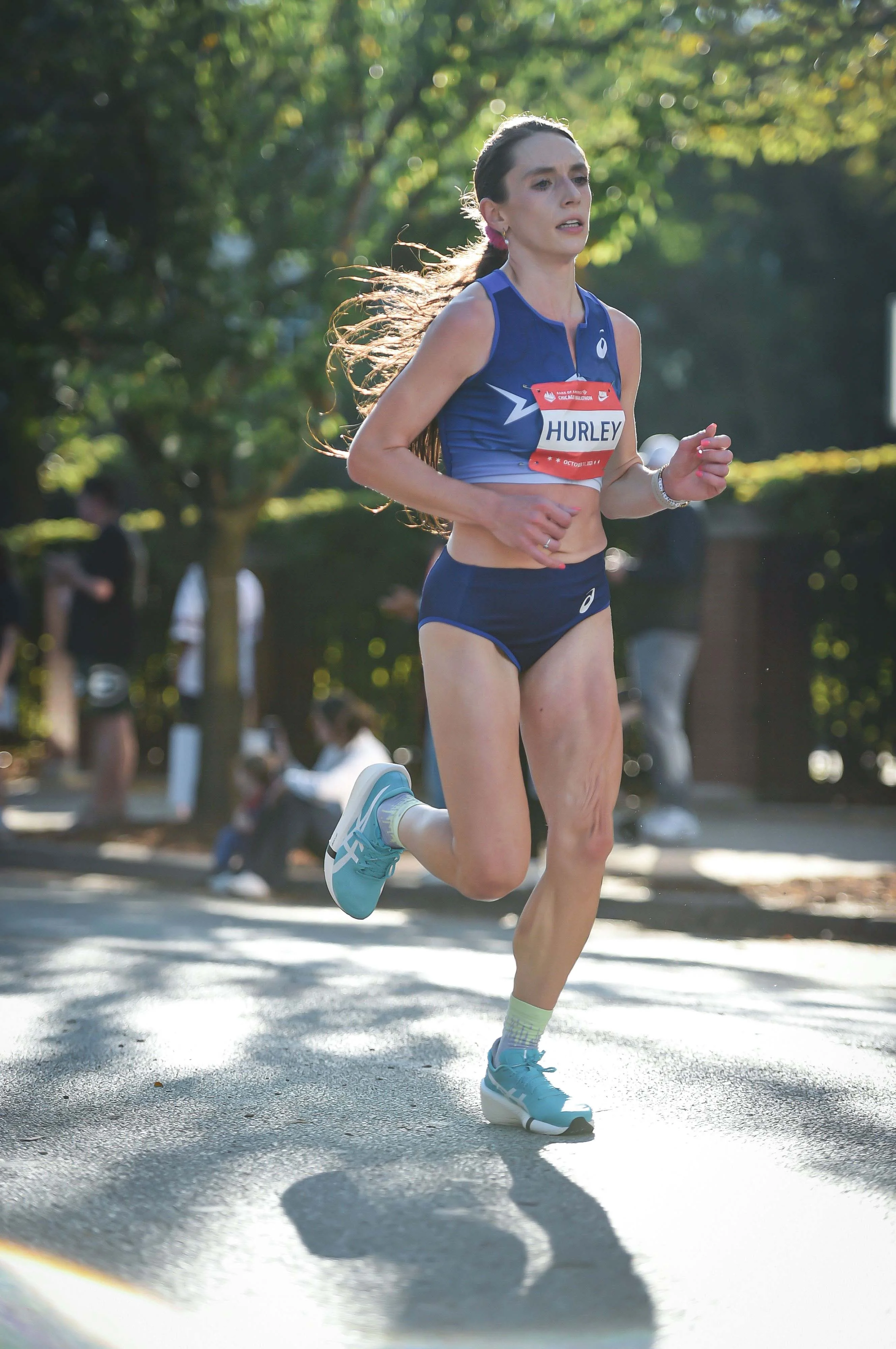 Hurley went to Chicago with serious ambitions. She had said she wanted a top-10 finish, and she and Kerr covered the opening 5K in 16:24—about 5:17 per mile—aiming to give her a shot at breaking 2:20, according to Begley.
But she also wanted to leave with a clear lesson for next time. When she pushed a mile at 5:15 between miles 19 and 20, then faded over the final 10K, she saw room to adjust rather than a reason to write off the race. “I think it’ll take some more processing,” she said afterward. “But I think if anything, I learned to maybe just be two to four miles more patient.”
Begley thought a fast time and the debut record were within her reach. Still, he treated the marathon as a first pass at a difficult event: learn how it unfolds, review the choices, then try again. His longer view was to have Hurley better prepared by her third marathon, after Chicago and a fall race the following year, with the Trials also ahead.
The practical lesson is simple: review what worked and what you’d change while the race is still fresh. A post-race analysis can turn a tough final stretch into a useful plan for the next start line.
Confidence Comes From Accumulated Evidence
Hurley didn’t enter college imagining a professional running career. She valued the Begleys’ confidence in her, but wasn’t sure she could meet their expectations. Over time, her performances—and how she’s handled training—have made that future feel more plausible. She won the 2024 USATF Running Circuit and ran 1:08:26 in her half marathon debut later that year. In 2026, she won the USATF 10-Mile Championships at the Cherry Blossom 10-Miler, then the USATF 25K Championships in Grand Rapids, Michigan. She also says she can now handle harder training sessions with less fatigue. Progress can be hard to see while you’re making it. Each step may feel manageable on its own; looking back reveals how much ground you’ve covered. Hurley’s sights extend to 2028 and even 2032. After Chicago, she said she was more excited about her marathon future than before the race: “I can’t wait.” Big goals can feel intimidating, whether you’re aiming for an Olympic team, Boston qualification, or your best possible 26.2 miles. The point isn’t to make the ambition smaller. Break the work into steps, and each one can give you a clearer reason to believe the next is within reach.Cindy Kuzma is a contributing writer and freelance health and fitness writer, author, and podcaster. She has contributed regularly to Runner’s World since 2013 and coauthored Breakthrough Women’s Running: Dream Big and Train Smart and Rebound: Train Your Mind to Bounce Back Stronger from Sports Injuries, published by Bloomsbury Sport. She covers injury prevention and recovery, everyday athletes, and Chicago’s active community. More at cindykuzma.com.