How to Livestream the Western States 100, the Oldest and Most Storied 100-Mile Trail Race in the World
Every year on the last weekend of June, the Western States Endurance Run reminds the ultrarunning world why it remains the gold standard of the sport.
The 53rd running of the 100.2-mile race from Olympic Valley, California, to the small foothills town of Auburn could be one of the fastest yet. But with increased attention to trail and ultrarunning, it’s gathering a new level of interest with more traditional media and social media influencers than ever before having applied for credentials to cover this year’s race.
From the base of Palisades Tahoe ski area, 370 runners will set out early Saturday at 5 a.m. PST (8 a.m. EST) on a rugged journey westward through the Sierra Nevada mountain range—crossing over the 8,750-foot summit of the Emigrant Pass, traversing into steep canyons, and fording the American River—before finishing on the track at Auburn’s Placer High School.
It is the oldest and most storied 100-mile trail race in the world, a crucible of heat, altitude, and accumulated suffering that has humbled legends and made new ones since the first official race in 1977. The roots and inspiration of the race are tied to the historic Tevis Cup equestrian race and the legendary run of Gordy Ainsleigh, who opted to run the entire 100-mile Tevis course in 1974 after his horse came up lame earlier in the week.
This year’s edition will feature what many consider the deepest women’s and men’s fields ever assembled, with past champions, course-record holders, and world-class first-timers all chasing the same finish line. Despite having a relatively small race field, the Western States 100 is known for its historical legacy and the strong community of runners, volunteers, supporters, and fans.
“It’s like no other race in the world,” said legendary Spanish runner Kilian Jornet, the 2011 winner who returned last year and finished third. “It’s always a competitive race at the front, but the golden hour at the 30-hour mark is something that you cannot find anywhere in the world. If you tried to recreate this race in modern times, it would never happen. And that’s what makes it so unique.”

How to Watch the 2026 Western States 100
The Western States 100 will be broadcast live on the race’s YouTube channel, kicking off Saturday at 4:30 a.m. PST (7:30 a.m. EST) and running through the 30-hour cutoff at 11 a.m. PST (2 p.m. EST) Sunday. Last year’s stream drew more than 750,000 viewers across 120 countries. You can also track the action through the official race leaderboard and the race’s Instagram feed.
If you want to watch the leaders finish, block off Saturday evening. Jim Walmsley’s men’s course record of 14:09:28, set in 2019, projects to a 7:09 p.m. PST (10:09 p.m. EST) arrival, while Courtney Dauwalter’s women’s record of 15:29:33 from 2023 would put a record-breaking finish around 8:29 p.m. PST (11:29 p.m. EST). Tune in to the last hour on Sunday at 10 a.m. PST (1 p.m. EST), if you want to be inspired by the final finishers of what is known as “golden hour.”
The Lore of the Western States 100
The Western States 100 remains the most prominent trail race in North America and one of the most sought-after trail-running race entries in the world. The race has addressed the evolving challenges of commercialism and professionalism while also prioritizing inclusivity, with ongoing efforts to attract more women and a more diverse field of runners.
The majority of the runners in this year’s race were chosen through a weighted lottery held in December, but last year’s top 10 finishers received automatic entries, as did runners who earned “golden tickets” at qualifying races around the world and several runners who received special consideration entries from race sponsors. For this year’s race, a record 9,983 runners entered the lottery with a cumulative 68,724 tickets based on how long each runner has been trying to enter.
Aside from the distance, the biggest challenges of the race are the 18,000 feet of climbing and 23,000 feet of descending and the oppressive heat in the canyons along the American River. Last year, 285 of the 369 starters (77 percent) finished the race amid temperatures that reached 92 degrees at the 62-mile aid station in Foresthill and an estimated 110 degrees in the canyons.
However, this year’s weather forecast looks more favorable for runners, with high temperatures expected to be in the high 60s with cloudy skies and a slight chance of light rain showers, conditions that suggest the course records could be in jeopardy.
“The men’s and women’s races should be some of the best we’ve ever had, especially because of what we think will be cooler weather, but it’s always more than just a race at the front,” says Topher Gaylord, president of the Western States Board of Directors and a seven-time finisher of the race. “It’s a meaningful and exciting race for every single runner who is endeavoring to reach the finish, as well as for their pacers and their crew and their families, because it takes a village to get there. For some, it’s a once-in-a-lifetime moment, but for others it’s something that inspires them to want to come back again.”

Top Contenders in the Men’s Race
Defending champion Caleb Olson and runner-up Chris Myers are both absent due to focusing on the Ultra-Trail du Mont-Blanc race in Chamonix, France, later this summer, but their departure may barely register. The men’s field of this year’s Western States 100 reads like a who’s who of the sport’s all-time greats, headlined by Walmsley, 36, a four-time champion and course-record holder from Flagstaff, Arizona.
While he has already established himself as one of the best to ever run Western States, the 38-year-old Jornet, a three-time Western States podium finisher, is considered by many to be the GOAT of trail running, in part because he’s also a five-time Hardrock 100 champion and four-time UTMB winner, as well as a 10-time winner of the 19-mile Sierre-Zinal race in Switzerland. He was seeking his 12th victory in the Zegama-Aizkorri trail marathon in Spain on May 17, but he finished a distant 43rd place after being slowed because of a recurring knee issue.
However, Jornet says he’s healthy and ready to go. He trained on a treadmill in 100-degree, sauna-like conditions at his home in Norway to prepare for the course that he says is very challenging but also very special to him.
“Every course is challenging for its own reasons,” Jornet said. “For Western States, you start in the mountains and go over the high peak, then you run down to the rugged canyons where you have to manage the heat and all of the downhill that destroys your legs. But yet you still need to run fast at the end, which is very difficult. The fact that you need to keep pushing late in this race and keep running faster on the flatter sections at the end while dealing with the heat makes this race probably one of the hardest I have ever done.”

It will be especially hard this year with the deep field of contenders. Adam Peterman (30, Missoula, Montana), the 2022 Western States champion, Hayden Hawks (35, Cedar City, Utah), a two-time podium finisher, and accomplished first-timer Zach Miller (37, Manitou Springs, Colorado) have all been running big miles in the Rocky Mountains, while European stalwarts Francesco Puppi (34, Italy), Vincent Bouillard (32, France), and Thomas Cardin (31, France) have all recently arrived after training overseas.
Other top challengers include returning top-10 finishers Jeff Mogavero (32, Missoula, Montana), Daniel Jones (35, New Zealand), Ryan Montgomery (32, Hanover, New Hampshire), Hans Troyer (26, Boulder, Colorado), and Hiroki Kai (31, Japan), plus fast first-timers Jeshurun Small (27, Golden, Colorado), Will Murray (31, Blairstown, New Jersey), Canyon Woodward (33, Franklin, North Carolina), Max Yanzick (23, New Zealand), Tracen Knopp (27, Anchorage, Alaska), Jordan Bramblett (29, Paulden, Arizona), and Jacob Banta (31, Mill Valley, California).
Also in the elite field are Anthony Costales (37, Salt Lake City), who was third at Western States in 2023, Jeff Browning (54, Flagstaff, Arizona), a four-time top-10 finisher who was 18th last year, John Kelly (41, Butler, Tennessee), who is a three-time finisher of the daunting Barkley Marathons, and Justin Grunewald (40, Boulder, Colorado), who finished second at last summer’s Leadville 100.

Top Contenders in the Women’s Race
This year’s women’s field includes 12 women with previous top-10 Western States finishes to their credit. That includes eight of last year’s top 10 finishers, including defending champion Abby Hall, 35, of Flagstaff, Arizona, and Fuzhao Xiang, 34, of China, who was the runner-up for the second straight year, and two-time third-place finisher Marianne Hogan, 36, of Montreal.
Hall made a profound comeback last year after devastating knee and leg injuries didn’t allow her to start in 2023. Xiang and Hogan have also been together training in Flagstaff for the past few months and recently completed a robust 42-mile rim-to-rim-to-rim run in the Grand Canyon.
“I think I am drawn to this race because of the hype around it, in the sense that it’s always an honor to be able to be on this start line with so many great runners,” Hogan says. “And it’s not something that I take lightly. So I always want to give it my best shot. I like the trails out on the course. They’re very runnable and the landscape is amazing. But I also really like the combination of all the different things that can go wrong in this race and how you have to manage those things that to have success.”
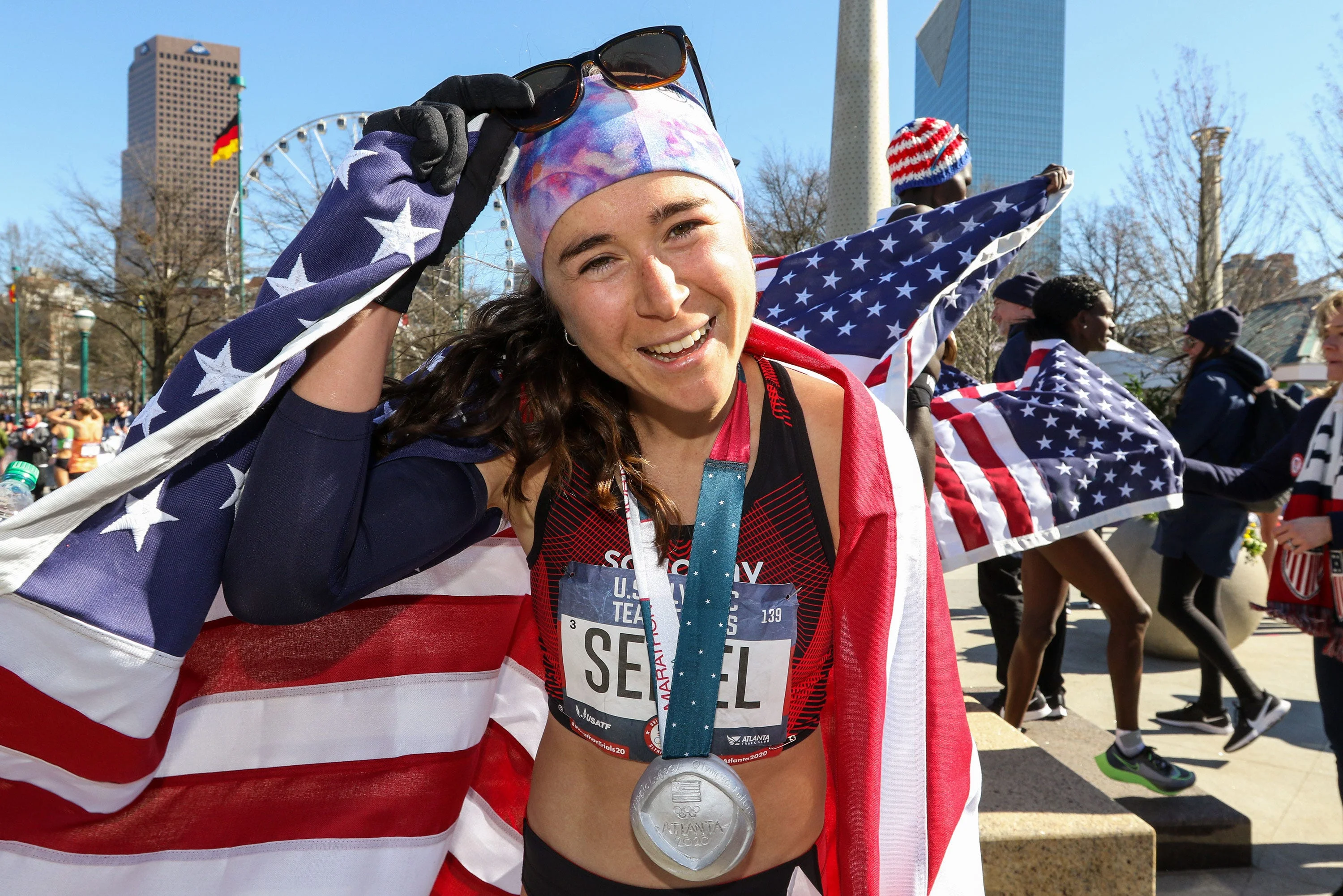
Additional top-10 returnees Fiona Pascall (36, Great Britain), Hậu Hà (37, Vietnam), Hannah Allgood (34, Colorado Springs), Caitlin Fielder (33, Andorra), and Emily Hawgood (31, Zimbabwe) could be contenders again, but the most talked-about runners entering the race are fast Western States newcomers Jenn Lichter and Molly Seidel, who are each making their debut at the 100-mile distance after earning golden tickets earlier this year.
Lichter (29, Missoula, Montana) has excelled at shorter distances on the trails until this year, when she won Arizona’s Black Canyon 100K in a course-record time. Seidel (31, Flagstaff, Arizona) earned the bronze medal in the marathon at the Tokyo Olympics in 2021 and several other top-10 finishes in World Marathon Majors, but she has transitioned to the trails this year with impressive results, including an outright victory in the Bandera 50K in Texas in January.
Other top contenders with strong racing credentials include golden ticket winners Riley Brady (30, Boulder, Colorado), Martyna Mlynarczyk (36, Poland), Anna Tarasova (42, Spain), Lotti Brinks (30, Boise, Idaho), Tara Dower (32, Durango, Colorado), and Addie Bracy (39, Buena Vista, Colorado).
Other Runners to Watch
Among the 27 runners aged 60 and older in this year’s field, the eldest is Gilles Cote, 69, of Kalaheo, Hawaii, who secured his spot through the lottery and is chasing his first finish. Close behind him in seniority is Peggy Alfred, 67, of Los Gatos, California, a longtime Western States volunteer returning for what she hopes will be her third finish. Among age-group runners, Dan Barger, 60, of Steamboat Springs, Colorado, and Charley Jones, 54, of Folsom, California, are the most experienced runners in the field with 15 Western States finishes to their credit.
Brian Metzler is a Boulder, Colorado, writer and editor whose work has appeared in Runner’s World, Sports Illustrated, ESPN, Outside, Trail Runner, The Chicago Tribune, and Red Bulletin. He’s a former walk-on college middle-distance runner who has transitioned to trail running and pack burro racing in Colorado.