What Western States 100 Training Data Reveals About How to Maintain Performance Late in a Race
Training for a 100-mile race can seem almost mythical from the outside, as if the only way to finish is to stack endless miles, check off monster long runs, and possess a willingness to suffer more than everyone else.
But data from TrainingPeaks on 63 finishers of the 2025 Western States 100 suggests a more useful lesson for runners: Going longer is not about doing more; it’s about consistently doing what’s necessary to build race-day durability.
Representing about 21 percent of the race’s finishers, the group of runners that make up this dataset includes 47 men and 16 women. So while the following numbers aren’t a universal formula for how to finish a 100-miler—there is no such thing—they are a snapshot of successful training that led to conquering one of ultrarunning’s most iconic races.
We tapped coach Cliff Pittman, CPT, to help interpret the data and translate it into actionable insight for all runners. He breaks down the four most effective takeaways, and how you can incorporate them into your training to build the late-race stamina needed to run longer.
Increase Mileage, But Don’t Go Crazy
The data from TrainingPeaks shows that Western States finishers run a lot—but maybe not the gargantuan mileage many runners might imagine.
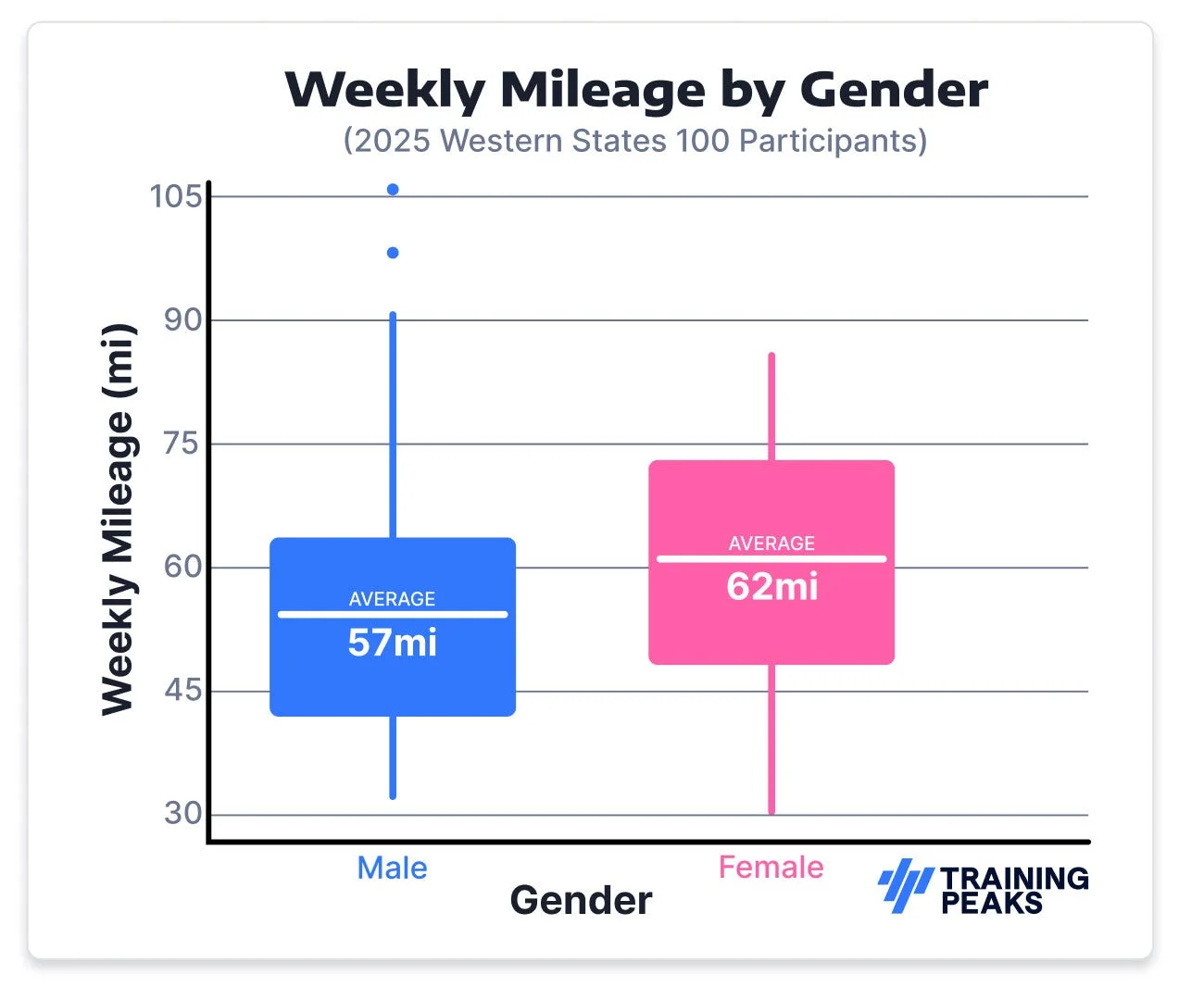
In the final 12 weeks before the 2025 race, women in the TrainingPeaks sample averaged about 62 miles (98.4 kilometers) per week, while men averaged roughly 57 miles (91.2 kilometers). Those are serious numbers, but aren’t wildly different from what many competitive road marathoners might log during a build.
The difference, Pittman says, is what those miles contain.
“Especially for a road runner, 60 miles a week is really not that much,” Pittman says. “But when you factor in that it’s trail and these runners are probably getting in somewhat similar to race-day elevation change, a 60-mile week on the trails can suddenly take twice as long as what a 60-mile week will on the roads.”
Mileage numbers are less about a magic weekly target and more about total training stress, Pittman says. In ultrarunning, a mile is usually not flat. Complicated technical terrain, climbing, and descending can meaningfully affect each mile.
Long run data reinforces this claim. The average longest run logged by the men in the sample was about 43 miles (69.7 km) and took 8.91 hours. For women, the average long run came out to 42 miles (67.8 km) and took 8.65 hours. Regardless of gender, the runners didn’t even clock half of the race distance in their longest long runs.
The purpose of the long run is to spend enough time moving to “stress test” important aspects of your race, Pittman says. You can refine elements of racing like fueling, hydration, sodium balance, gear, pacing, and cooling in these long efforts. (Those cooling strategies might include water dousing, icing the skin surface, and cold water immersion.)
For runners looking to go longer, the lesson is simple: Don’t chase the biggest peak week or the longest long run. Build a level of volume you can repeat, recover from, and extend over time.
Tackle Race-Specific Training
The Western States course is mountainous, hot, exposed, and punishing on the legs. Training should match the demand of the race, and in this case, the data shows how Western States finishers prepared for the specific conditions they would face on race day.
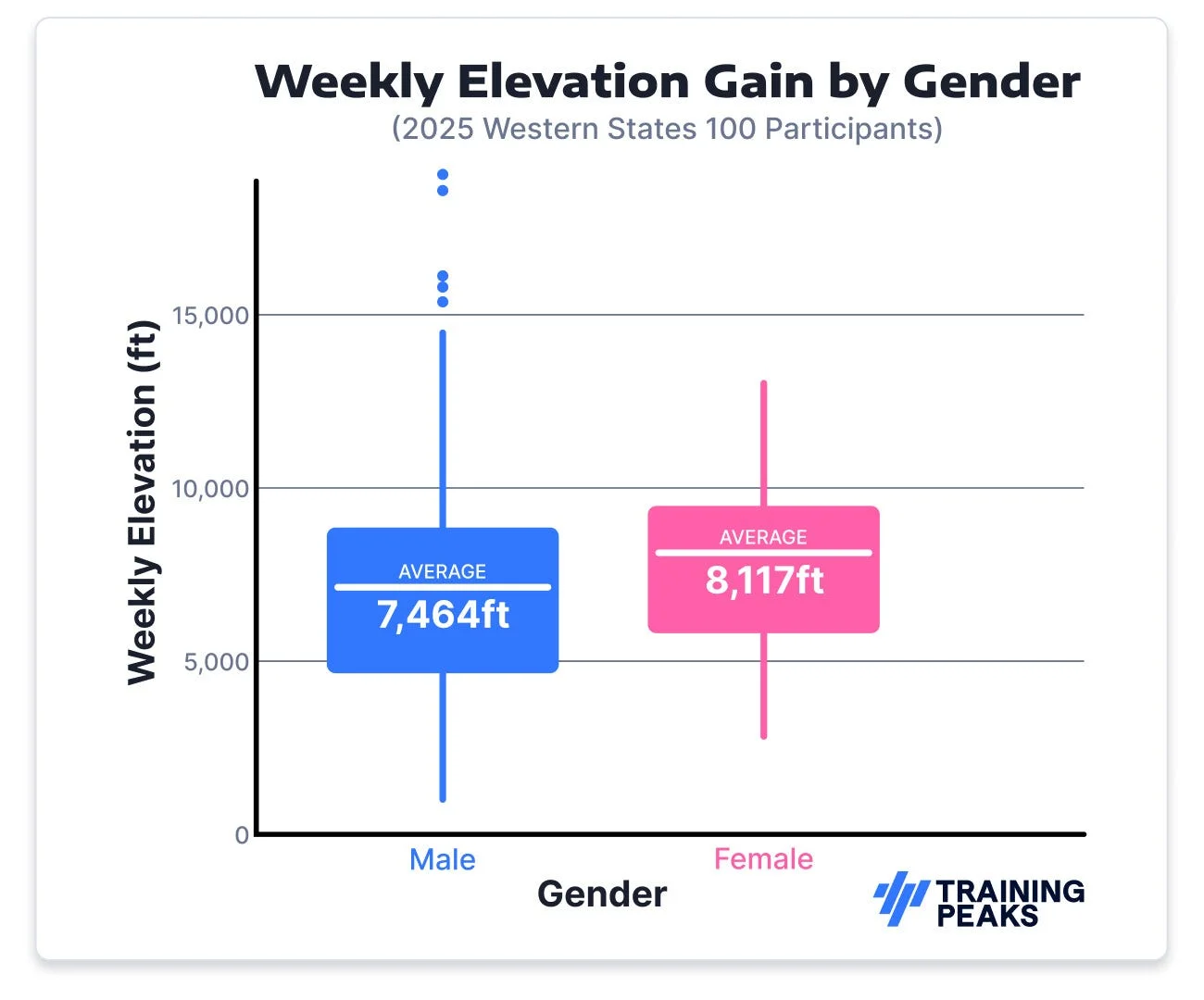
Women in the sample averaged roughly 8,100 feet (2,474 meters) of elevation gain per week while men averaged 7,500 feet (2,275 meters).
Pittman says that in long-distance races like Western States, traditional fitness metrics like lactate threshold and VO2 max still matter to some degree. However, the longer the race is, the more race-specific durability must take over.
“Durability is really everything,” Pittman says. “It’s the expression of fitness late into a race.”
For Western States, that means training the legs for climbing, and perhaps more importantly, descending. Pittman says downhill running creates major eccentric loading, especially in the quad muscles. If runners are not prepared for that, their quads will give out early and cause them to fizzle out as the race continues.
A road runner doesn’t necessarily need to mimic the vertical incline training you’d see in Western States athletes, but it’s smart to study the demands of the race you are running so you can prepare for it during training.
For example, the Boston Marathon demands success on early downhills to power through Heartbreak Hill between miles 20 and 21. The New York City Marathon requires runners to handle bridges and late-race rolling hills. A local summer half marathon may require more attention to heat and humidity over hills.
At the beginning of a training block—about six months out from a race—Pittman usually has his ultrarunners doing high-intensity VO2 max work, for example, in an effort to build general fitness first. Then, around 12 weeks before the race, he begins to rely heavily on race-specific efforts, which, for ultrarunners, are long and slow runs with plenty of elevation changes. For a marathoner or half-marathoner, it might look like long runs with race pace mixed in or long runs with hills for races that do have elevation gain.
No matter what race you’re doing, the closer you get to race day, the more your training should resemble the demands you will actually face, Pittman says.
Take Advantage of Cross-Training
One of the clearest patterns in the data had nothing to do with running. According to TrainingPeaks, 95 percent of the athletes in the set recorded a sport other than running in the 12 weeks leading up to race day. Sixty-two percent of the athletes recorded cycling or swimming at least once, while 44 percent recorded cycling or swimming in at least eight of the 12 weeks, showing a commitment to those methods for cross-training.
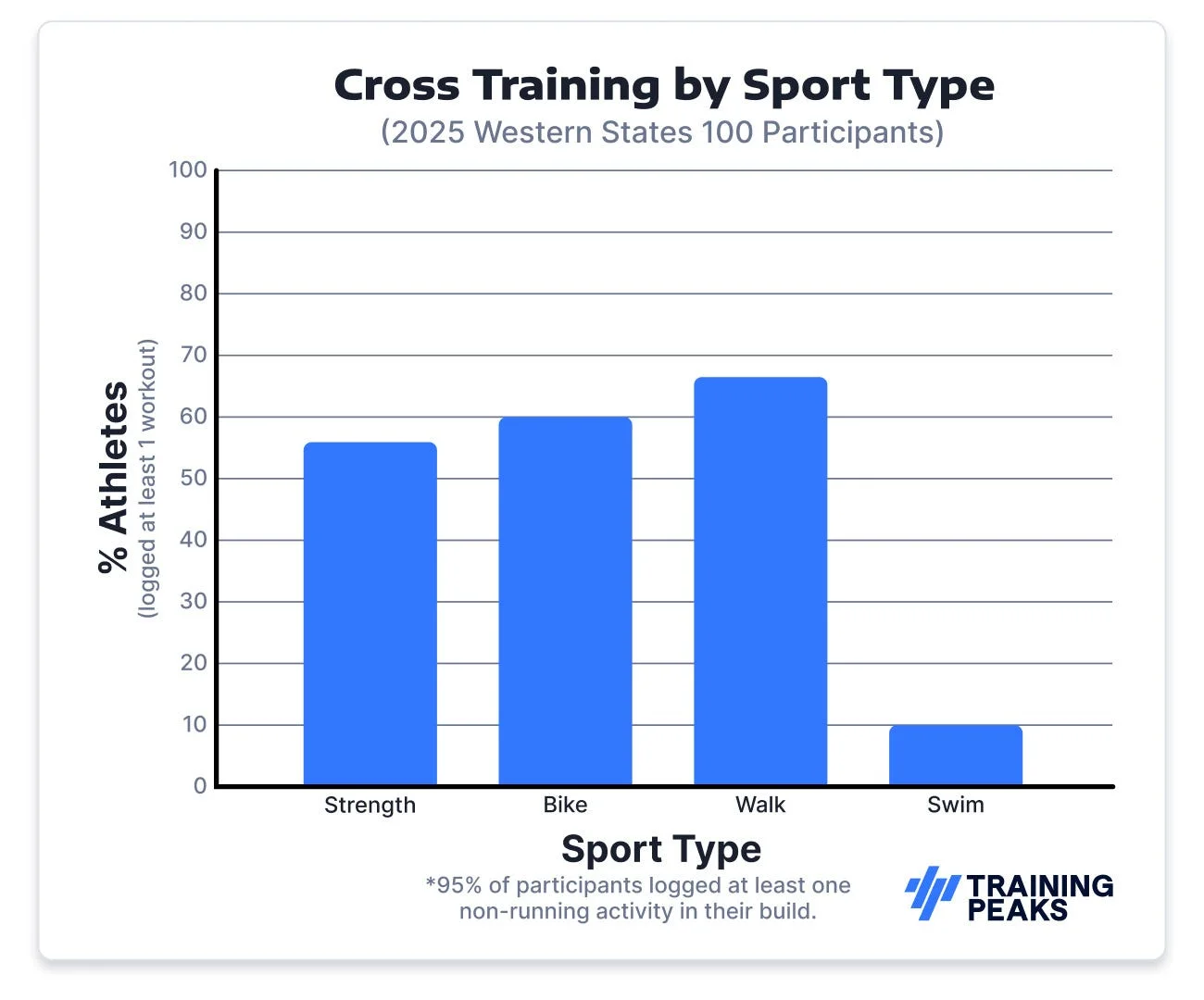
Pittman says runners should interpret the numbers carefully because there are a few reasons why runners may use cross-training. At this point in training, some athletes may hit a wall with their volume and turn to cross-training to add aerobic work without extra impact, Pittman explains. Others may have deliberately spread training across different modalities to avoid those roadblocks in the first place, and some may use it for active recovery.
When it comes to cross-training, Pittman says there’s one major caveat that runners need to keep in mind: It should reinforce your run training, not replace it.
“There’s nothing more specific to 100-mile performance than running,” Pittman says. “If athletes are leaving run training on the table because they’re on the bike or in the pool, they’re missing out on race-specific fitness.”
But cross-training can help runners become more durable. Pittman recommends it earlier in a long-distance training cycle when runners are doing more high-intensity general fitness work, as mentioned above. Focus on keeping the impact low while still exercising the aerobic system, as you do in cycling, swimming, and rowing, and stay mostly in zone 2 effort.
Add Strength and Heat Training
More than half the athletes in the TrainingPeaks data also logged strength training during their builds, averaging 19.6 sessions per person over the 12-week sample. This averages out to about one to two strength workouts per week.
Pittman suggests runners lift heavier weights in the gym to build power, a quality that running alone does not maximize. For trail and ultrarunners, heavy lifting can help them tolerate downhill running and long climbs, improve their ability to carry packs and poles, stave off fatigue, and better handle running on fatigued legs.
For road runners, the same principle applies, just slightly differently. Strength training boosts running economy (helping you run faster with less effort) and helps the body withstand the repetitive stress of high-impact road miles.
Heat training—either active exposure during training runs or passive exposure with sauna or hot tub sessions—was another notable part of the data, as it showed up in 56 percent of the athletes’ logs. For Western States, Pittman says that number seemed low, given how prevalent heat usually is on race day.
For heat training, Pittman prefers his athletes complete their normal run first, then add passive heat exposure afterward. The goal is adapting the body to heat without sacrificing the quality of the run.
Overall, the data reads less like a collection of extreme cases and more like a pattern of careful choices designed to build durability. “Western States finishers aren’t really doing anything mysterious,” Pittman says. “They’re just training consistently and doing things to protect their ability to keep running.”

Matt Rudisill is an Associate Service Editor who has been with Runner's World since 2025. A Nittany Lion through-and-through, Matt graduated from Penn State in 2022 with a degree in journalism and worked in communications for the university's athletic department for three years as the main contact and photographer for its nationally-ranked cross country and track & field teams. Matt was also heavily involved in communications efforts for Penn State football, men's basketball, and women's gymnastics. In his role with Runner's World, Matt has interviewed Olympians, world champions, and countless experts in the field to create service content that helps runners of all ages and experience levels train smarter and race faster. When he’s not out jogging, Matt can be found tweeting bad takes about the Phillies or watching movies.