Older Runners Have Reshaped College Track and Cross Country. A New Age-Based Rule Could Change That
A new policy change in the NCAA could upend the way the top track and cross-country coaches recruit in the coming years.
This week, the NCAA Division I Cabinet approved a new rule that standardizes the eligibility clock across every sport. Under the new model, an athlete’s clock starts either when the athlete enrolls in college or at the start of the academic year after the athlete turns 19, whichever comes first.
From there, the athlete will have five years of eligibility over five years, effectively eliminating redshirt seasons. (There are exceptions for military service, religious missions, and pregnancy, and current athletes can be grandfathered in.)
The policy, which takes effect for athletes enrolling in fall of 2027 or later, is a departure from the current system, which has no cap on ages and gives athletes five years to use four years of eligibility. This is especially relevant in collegiate distance running, where several of the top athletes in Division I are well into their mid-20s and from the distance running hotbed of Kenya.
There have been a number of older-than-typical runners who have placed high at major races the past year.
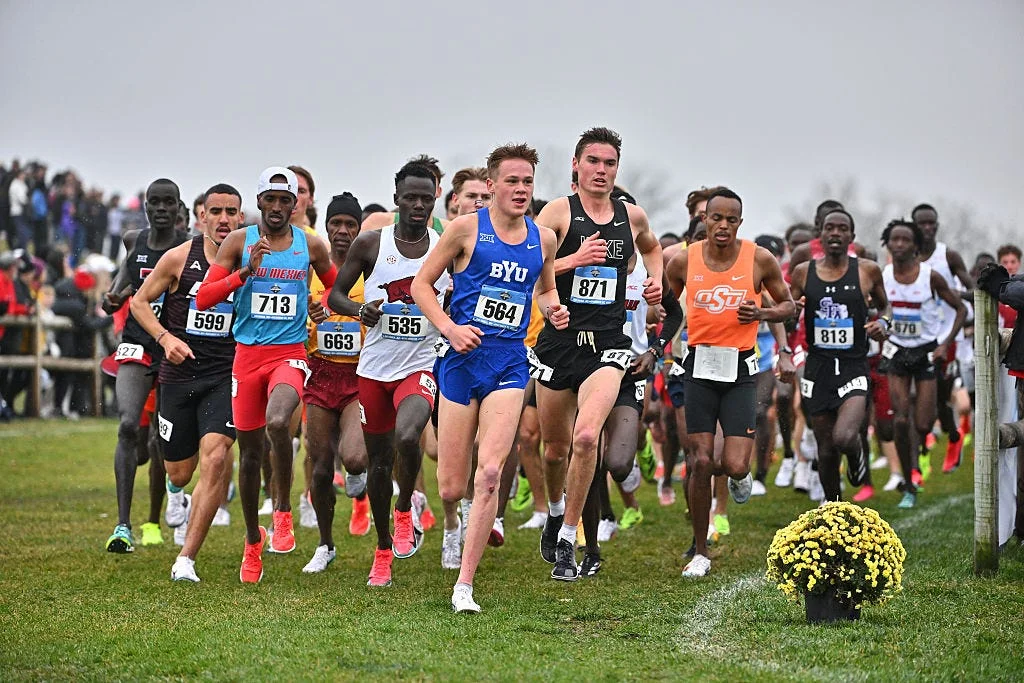
At the 2025 NCAA Cross-Country Championships, Solomon Kipchoge, a Washington State sophomore who was 29 on race day, finished third. Alabama sophomore Dismus Lokira, then 27, placed 11th, and Florida freshman Kelvin Cheruiyot, then 25, finished 14th. All three are from Kenya.
On the track, freshman Mercyline Kirwa of Iowa State won the national title in the women’s 10,000 meters at 26 years old, and Louisville sophomore Geoffrey Kirwa was 24 when he won the men’s 3,000-meter steeplechase. (Both are Kenyan.)
Some coaches, including Ed Eyestone of BYU, have spoken out against schools that predominantly recruit top-end talent from overseas.
Eyestone criticized recruiting services that bring in (at times, older) international talent to the U.S. last November. “It doesn’t help the U.S. developmental effort,” he said to Deseret News. “It doesn’t encourage young American talent; it discourages them. [International athletes] take scholarships and roster spots and the limelight.”
He views the new rule as a step in the right direction. “By and large, it’s a very positive thing,” Eyestone said to Runner’s World in a phone call on Thursday. “I don’t think you’ll find many coaches that are feeling too bad about it.”
Rita Gary, the women’s head coach at Furman University, has also been vocal that traditionally college-aged athletes are at a disadvantage to older athletes. In an op-ed in Track and Field News on Wednesday, she wrote:
“An 18-year-old entering college directly from high school is not competing on equal footing with a 24- or 25-year-old who has spent years training, competing, and physically maturing. The difference is not simply athletic. It is physiological, psychological, and experiential.”
Roster limits have also amplified the tension. After the House settlement was passed last year, many top programs became subject to smaller roster sizes in cross-country and track, potentially making older recruits more attractive than younger runners who may need more time to develop.
A recruiting shift
Many of these Kenyan athletes come to the United States via recruiting services from three major players: Scholarbook Premier, Townhall Athletics Club, and Complete Sports. The agencies partner with schools, which pay them sizable fees for access to top-end talent. (Scholarbook, for example, charges $30,000 for access to its fastest Kenyan prospects.) Coaches tell the agencies what level of runner they’re looking for, and the recruiting services connect them to the athlete and help with logistics like securing a visa and ensuring the athletes are academically eligible.
Philipp Baar, the head of track and field at Scholarbook Premier, told Runner’s World that many coaches have become risk-averse in their recruiting strategies. Why take a chance on an unproven 18-year-old when you can land a 22-year-old who has already run elite times?
“Right now, everyone wants this sure thing,” he said. “No one wants to take a risk.”
Baar said the new age rule will likely cause a shift. Recruiting services (and coaches) will have to identify talent earlier, and because the talent pool will be smaller, Scholarbook will likely face increased competition from other agencies jostling for the same promising runners.
Baar, however, is in support of the new rule.
“The main changes, I think, are going to have to come from the coaches, who are going to have to change the way they recruit,” he said. Instead of functioning like front-office general managers, Baar believes that the coaches who develop athletes will benefit the most.
“They’re going to have to stop being managers and start being coaches again,” he said.
Age discourse reached an inflection point during the summer of 2024 when Texas Tech, via Scholarbook, signed Kipchoge—a then-28-year-old who had run faster than the American record in the half marathon at the time. Kipchoge entered as a freshman and faced a barrage of criticism on social media. (He has since transferred to Washington State.)
“He kind of became the scapegoat of all of this bottled-up anger toward [international runners],” Baar said.
“You can’t really blame the individual for wanting to get a good opportunity and everything being absolutely legal,” he continued.
Since then, Baar said Scholarbook has largely shifted away from working with athletes in their mid-to-late 20s. He noted that administrators at certain schools, including a nationally ranked SEC program, have instructed coaches to not recruit older athletes to avoid potential backlash.
Although there will be a smaller pool of runners to recruit from and the younger athletes may be more of a gamble, Baar said he supports the new policy because it seems more fair to athletes across the NCAA.
“I do think that collegiate athletics should be about developing or bridging the gap from high school sports or junior sports to pro sports. It shouldn’t be the pro sports,” he said. “So I think it’s a good thing.”
Eyestone agrees. Above all, he thinks that the new rule helps level the playing field.
“I’m all for international athletes,” he said. “International athletes made me better when I came through the college ranks. Competing against Suleiman Nyambui, Gidamis Shahanga, and Zack Barie from UTEP made me better because I had to run faster.” (Eyestone was a four-time NCAA champion at BYU in the 1980s.)
“But I think what this does is it allows us to compete with the international athletes that are equivalent in age, and I think that’s a big step forward.”

Theo Kahler is the senior news editor at Runner’s World. He’s a former all-conference collegiate runner at Winthrop University, and he received his master’s degree in liberal arts studies from Wake Forest University, where he was a member of one of the top distance-running teams in the NCAA. Kahler has reported on the ground at major events such as the Paris Olympics, U.S. Olympic Trials, New York City Marathon, and Boston Marathon. He’s run 14:20 in the 5K, 1:05:37 in the half marathon, and finished 40th at the 2025 New York City Marathon. He enjoys spotting tracks from the sky on airplanes. (Look for colorful ovals around football fields.)