‘I Had Never Trained for a Race in My Life. Here’s How I Completed a 10K in 6 Weeks—and Placed in My Age Group’
Throughout high school, my life revolved around field hockey, as a player and captain of my team. When I got to college, I let health and exercise slip away and completely stopped working out, consumed with school and friends.
This past year, though, when I started working full-time at Runner’s World, I decided to become more active again and figured I would jump on the popular running train. (The fact that it surrounded me at work helped give me the nudge I needed!)
When the new year rolled around, I made a resolution to run a 10K. A half marathon seemed way too ambitious, but I felt like I could really stick to training for a 10K—I had never done one before and would take it more seriously than a 5K, I thought.
Before I started training for the 10K, I was probably a little overconfident in my athletic history. I went for a run on the treadmill at my local Planet Fitness in January, and found I could only get to a half mile before needing to stop and walk.
I hated the treadmill. It was so boring to me. I thought I’d maybe be able to keep running farther if I was outside, but it was simply too cold for me. So I kept trekking to the treadmills at the gym a few times a week as I worked up to running a mile by the spring.
During a weekend visiting my hometown in Westchester, New York, I saw a sign posted at a local park for the New Castle Road Race taking place on May 3, 2026. I had never heard of this race before seeing the flier, but it has happened every year for the past 30 years, with 5K and 10K race options. I convinced my hometown best friend to train for and race it with me. We kind of said to each other, “I’ll do it if you do it,” so we became accountability buddies quickly, checking in on each other’s Strava accounts regularly.
I downloaded the Runner’s World beginner 10K plan and shared it with my friend, too. I basically started with little-to-no formal running experience under my belt, but having a buddy to train with helped it feel more fun and manageable.
What My Training Looked Like
My training cycle as a whole was about figuring out what would keep me consistent and engaged in running. When I officially started training, I didn’t follow the plan perfectly for the first two weeks. I often turned the prescribed four-mile runs into two- to three-mile runs, and incorporated one-minute walk breaks. I knew I could complete two miles without stopping at that point, but needed a quick rest before each mile after that.
By the third week, I felt like I was on track to follow the training plan more closely. The plan mostly consisted of four-mile runs, which I enjoyed because it was the most satisfying distance to complete in my build. Four miles felt just challenging enough, and three weeks into the six-week plan, I could do four miles without stopping. I thrived on consistency and the gradual progression of mileage.
The plan also included one run a week with pickups or aerobic intervals at higher speeds, which I appreciated because it kept my runs exciting without feeling intimidated by speed. (I hadn’t done speed training in a very long time.) The weekly runs with gentle pickups felt like a fun game to me, gradually accelerating and decelerating throughout the run.
By the time it came to my longest long run, listed as seven or eight miles, I was in Boston, visiting my partner, Lily. I told myself I didn’t have to go the full seven miles; I could just stick to 6.2 and see how I felt. Lily rode their bike with me as I ran a six-mile loop around a beautiful park, and once I got past six miles, I felt good and figured I could do one more. The final mile felt choppy because I ran back and forth across short roads to hit the mileage, but I felt excited, like I could finish at a slightly faster pace. After I hit seven miles, I was super proud and confident that I could handle the 10K.
To keep the whole training build low-stakes, I would sometimes take an extra rest day if I needed it, to not burn myself out. I didn’t want to put pressure on myself and ruin the fun of training. I enjoyed alternating runs every other day with rest or a light strength training routine.
I didn’t have a strict time goal for the 10K, other than potentially finishing in under an hour, but really, I just wanted to have fun. Although my overall goal was to simply complete the 6.2 miles, the small incorporations of speed were very approachable and made me feel strong for race day.
How Training Paid Off on Race Day
My mom drove me to the race, and we wound up being the first people there. Initially, there were so few people showing up that I thought we could actually win the race for our age group. But as we got closer to the start time, more people showed up, and I realized that was going to be a lot harder.
My friend and I decided we wouldn’t be the type of running buddies to talk to each other during the race. Instead, we wanted to focus and lock into pace, so we could go sub-60. I listened to “Tribulations” by LCD Soundsystem as the first song on my running playlist, which pumped me up.
The course itself went through my hometown roads, which felt nostalgic and sweet to see all the roads I used to drive through and grew up near. But the course was super hilly, and I basically ran on no hills during training. (Noted for my next race to train for the terrain!)
I’ve heard that you’re often tempted to go out too fast at the start of a race from editing episodes of The Amazing Runner’s World Show. At first, my plan was to avoid doing that, but I felt embarrassed by all the people passing me and started picking up my pace anyway. Thankfully, I was still able to push hard and keep going.
During the race, I met a girl running around my pace for a majority of the race, who had previously run the Boston Marathon. Before the final mile, we chatted for a second and realized we had both been on the same field hockey team a few years apart. We pushed each other to finish strong, both crossing the line in just under an hour.
The minute I realized I could break one hour, I was determined to cross the line as fast as I could. I ended up finishing in third place for my age group, feeling super winded and tired with a side stitch, but really proud of myself and happy with my time of 59:27.
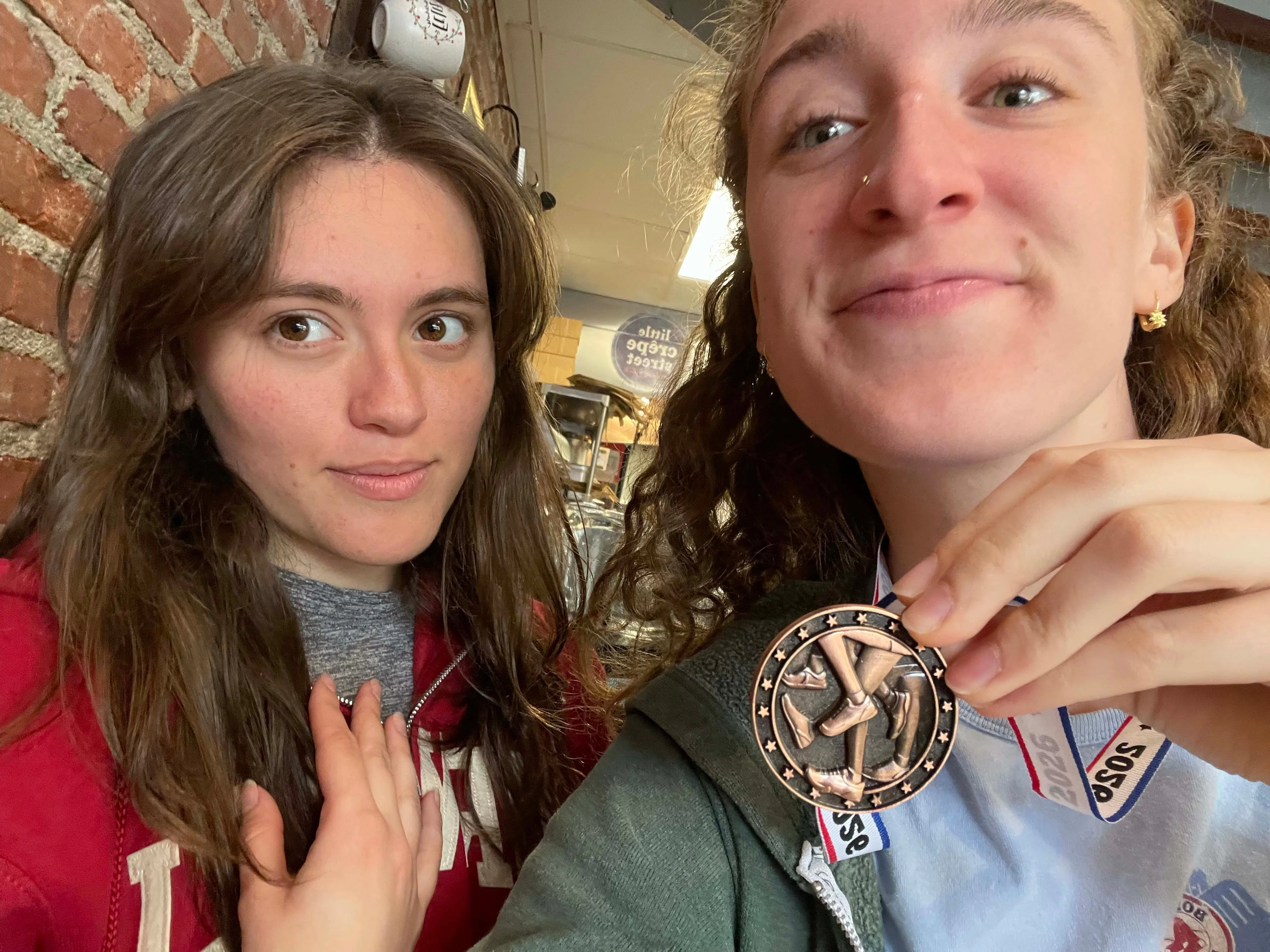
This race definitely inspired me to keep running and push myself to try farther distances. Next time, I want to use my next race experience to raise money for cancer research, following my mom’s recent breast cancer diagnosis. I grew up surrounded mostly by women in my family, and my mom’s strength inspired me most to do something hard and to push my body to its limits.
3 Tips for Training for Your First Race
1. Play Tricks on Yourself
The thing I struggled with most in training was consistency, and just getting myself out the door. I struggled with feeling like even though running is fun and I enjoy it at the moment, setting myself up to do it was hard. To deal with this, I kind of lied to myself. If I had a four- or five-mile run on the schedule, I told myself, “You don’t have to do that, though, you only have to do two miles.”
This made sense to me because if you get out of the house and you just do two miles, then it was still a good day in my head. It felt very achievable because it was under 30 minutes for me. Once I hit two miles, I almost always kept going to complete the full four or five miles anyway because I felt so good and it made doubling (or tripling) that distance not feel so scary.
2. Look for Structure
There was one moment before I started formal training where I got lost in the woods and had to wander around without any GPS or my phone. I felt so excited to be running outside in the woods, enjoying the scenery and the endorphins, away from the treadmill. I made the very nonstrategic decision to leave my phone and wallet in the car, and when I turned around to go home, I realized I couldn’t find my way back and the sun was setting.
There were a bunch of forks in the road and I wasn’t sure which way I came. After running around trying to find my way, I eventually found familiar neighborhoods and a bridge I recognized to lead me back to my apartment, where my partner could help me get back to my car.
This experience gave me the understanding that maybe there should be a little more structure to my running, and it forced me to have my phone on me at all times. I started tracking my runs with Strava so that wouldn’t happen again.
The Runner’s World Run Your First 10K training plan also completely took the stress out of training. I liked that following a plan meant I didn’t have to think about what run I was going to do. I just checked the plan, so the workouts were sort of out of my hands.
3. Don’t Take It Too Seriously
What worked really well for me in the beginning was running in a way that felt unserious to me, like jogging for as long as I wanted to, speeding up when I felt excited, and stopping for a bit to look at nature around me in local parks. I approached running with the mentality that it’s not that big of a deal, and I could just play around with it. I wanted to follow the plan and see where it led me, rather than fixate on a certain outcome.
I had a lot of associations with high school track and gym classes that made running feel very rigid, but this time around, I just wanted to move my body more.
I kept my supplemental strength routine low-stakes, too, doing basic glute exercises for about 30 minutes on my two non-running days, like a few sets of donkey kicks, squats, clamshells, and lateral banded walks.

Kristine Kearns, a writer and avid runner, joined Runner’s World and Bicycling in July 2024. She previously coached high school girls cross country and currently competes in seasonal races, with more than six years of distance training and an affinity for weightlifting. You can find her wearing purple, baking cupcakes, and visiting her local farmers market.